
ROTTERDAM, 24 June 2026 – Bospolder-Tussendijken has reached a major milestone in Rotterdam’s energy transition: the first part of the neighbourhood has been made largely natural gas-free. Almost 1,300 homes, four schools and neighbourhood centre Pier 80 have been connected to sustainable heat.
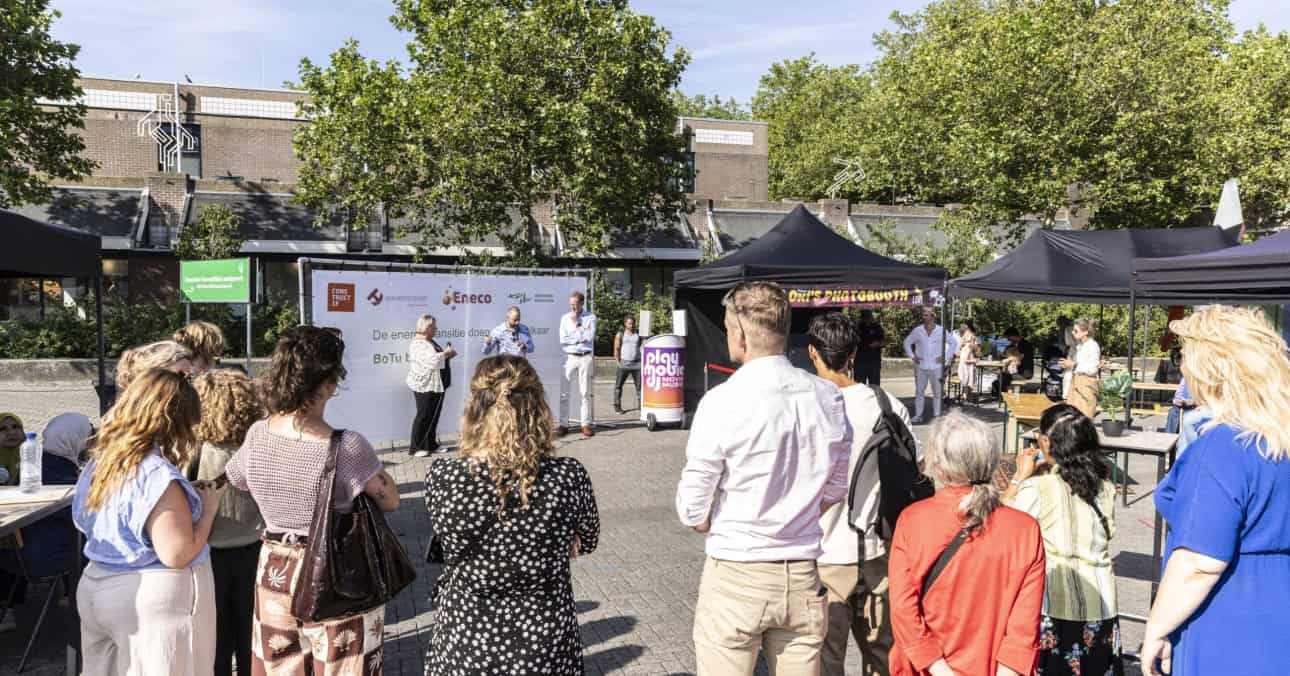
Image: Closing words by Ron de Wit, director of Heat and Cooling at Eneco, and Hedy van den Brink, chair of the board at Havensteder. Photo: Angeniet Berkers.
The milestone was celebrated with residents, entrepreneurs and partners on Visserijplein on 23 June. It makes BoTu the first existing Rotterdam neighbourhood where the transition away from natural gas has been completed at this scale.
BoTu moves to sustainable heat
The work in Bospolder-Tussendijken has been under way since March 2021. Street by street and home by home, the municipality of Rotterdam, housing corporation Havensteder and energy company Eneco worked with residents and local businesses to move the first part of the neighbourhood from natural gas to a heat network (warmtenet).
For this part of BoTu, a heat network was considered the most suitable and achievable alternative to gas. At the same time, a separated sewer system (gescheiden rioolstelsel) was installed, combining energy work with underground improvements that should make the area more resilient.
That combination matters in a dense existing neighbourhood. Making an area natural gas-free (aardgasvrij) is not only about replacing pipes and systems. It means working inside homes, opening streets, coordinating technical teams and keeping residents informed while daily life continues around the work.
The first part of the neighbourhood has now been completed according to the 2026 schedule. For Rotterdam, it is a visible step towards the city’s aim of becoming natural gas-free by 2050.
Do you run a business? RotterdamStyle is looking for a main sponsor. Get exclusive visibility across our website for a fixed fee. Interested? Contact us 🤝
Residents shaped the transition
The project was not treated as a technical operation alone. The energy transition reaches behind the front door, where residents have questions about costs, comfort, disruption and what changes in their own homes.
In BoTu, extra attention was given to communication and support. De Verbindingskamer and the Taalmilieucoaches helped answer questions, reduce concerns where possible and connect people in the neighbourhood.
Several resident-led initiatives also grew around energy and sustainability. Residents made heat panels to warm their feet, children joined energy and circularity expeditions in the neighbourhood living room twice a year, and creative actions helped bring the subject into public view.
One example involved decorating construction fences with plastic carrier bags from the market to draw attention to pollution. Residents also created a theatre performance to start conversations about the energy transition.
Do you run a business? RotterdamStyle is looking for a main sponsor. Get exclusive visibility across our website for a fixed fee. Interested? Contact us 🤝
A greener neighbourhood approach
Councillor Chantal Zeegers, whose portfolio includes climate, says BoTu shows how major changes begin locally. “BoTu shows that major changes begin in the neighbourhood. Thanks to the efforts of residents, entrepreneurs and our partners, something special has been achieved here. Not only sustainable heat for hundreds of homes, but also new connections between people. We can be proud of that together.”
Hedy van den Brink, chair of the board at Havensteder, says the change has a major impact on residents. “The transition to a natural gas-free home has a great impact on our residents. That is why we guide them through it step by step. We thank them for their cooperation and are extremely happy that we have achieved this result together: a future-proof neighbourhood that is therefore an example for the rest of the city. Together with Eneco and the municipality, we formed a strong coalition that made this possible.”
Ron de Wit, director of Heat at Eneco, says installing a heat network in an existing neighbourhood asks a lot from everyone involved. “The construction of a heat network in an existing neighbourhood requires a lot. In BoTu, it succeeded through good cooperation and by staying in contact with residents and entrepreneurs. Above all, it is a social transition, and that is what makes this result so valuable.”
The positive side of the BoTu approach is that sustainability became part of neighbourhood life rather than an abstract climate target. The result is cleaner heating for homes and public buildings, but also more knowledge, new local initiatives and a stronger network of people who have been through the process together.
Do you run a business? RotterdamStyle is looking for a main sponsor. Get exclusive visibility across our website for a fixed fee. Interested? Contact us 🤝
Lessons for Rotterdam
The BoTu project has produced lessons for other neighbourhoods in Rotterdam and beyond. The work has shown what is involved in construction below ground, carrying out changes inside homes and working with residents, entrepreneurs and owners’ associations.
Those experiences were shared with professionals from across the Netherlands during the BoTu Knowledge Day on 25 June. The lessons are expected to help shape future natural gas-free projects in other parts of the city.
Rotterdam is currently working on its Heat Programme 2027. This programme will set out the preferred alternative to gas heating for each neighbourhood and identify where work will take place in the coming years.
The city will then develop implementation plans together with energy companies, housing corporations, residents and entrepreneurs. The new heat programme is expected to be adopted in 2027.
Do you run a business? RotterdamStyle is looking for a main sponsor. Get exclusive visibility across our website for a fixed fee. Interested? Contact us 🤝
Towards natural gas-free Rotterdam
The completion of the first part of BoTu is one step in a much longer transition. Rotterdam wants to become natural gas-free by 2050, and existing neighbourhoods will be among the most complex places to make that happen.
Still, BoTu shows that the shift can be made in a lived-in part of the city when technical planning, resident support and local cooperation are treated as one shared task. Very Rotterdam, really: practical, complicated, social and built street by street.