
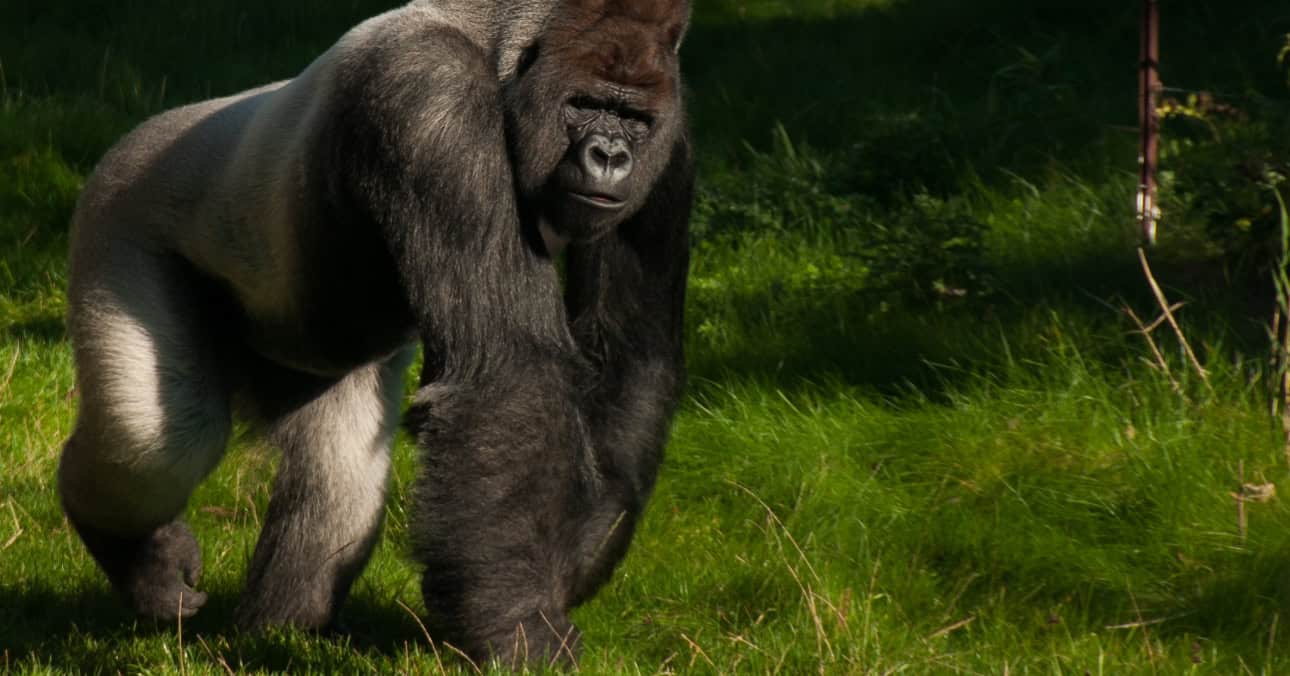
For nearly eighteen years, a gorilla named Bokito was one of Rotterdam's most recognisable residents, admired by zoo visitors, loved by his caretakers and remembered around the world for a dramatic escape that made international headlines. But behind the extraordinary events of 18 May 2007 was a much longer and more complicated story, one of an animal raised among humans, a powerful family leader and a Rotterdam icon whose legacy continues beyond his death.
Image: Bokito, 9 October 2010. Photo: Maarten Nijman
There are famous Rotterdammers, and then there is Bokito. He never walked the Coolsingel, never attended a football match at De Kuip and never said a word anyone could understand. Yet his name became familiar in households across the Netherlands, entered the Dutch language and eventually prompted a discussion about whether he deserved a statue.
For an entire generation of visitors to Diergaarde Blijdorp, Bokito was a familiar figure. Children grew up watching him, regular visitors followed his family and his caretakers came to understand his individual character. To people outside Rotterdam, however, he was often simply the gorilla who escaped.
Both histories belong to him. To understand why Bokito became such an enduring part of Rotterdam's identity, we have to travel back to where his story began.
Do you run a business? RotterdamStyle is looking for a main sponsor. Get exclusive visibility across our website for a fixed fee. Interested? Contact us 🤝
From Berlin to Rotterdam
Bokito was born on 14 March 1996 at Berlin Zoo in Germany, the son of gorillas M'penzi and Derrik. His earliest years were unusual. Because his mother could not adequately care for him, he was hand-reared by zookeepers rather than raised entirely within a gorilla family.
One of his principal carers was Reimon Opitz, the head of Berlin Zoo's ape house. Together with his wife Marion, Opitz helped raise the young gorilla, feeding him with bottles and caring for him in the family's accommodation above the ape house.
Bokito's upbringing brought him into unusually close contact with humans. As a youngster, he became familiar with their presence and routines, an experience that distinguished him from gorillas raised primarily by their own species.
An extraordinary episode from his Berlin years illustrates just how unusual that relationship was. In June 2004, the eight-year-old Bokito escaped his enclosure. He managed to get onto the terrace of the apartment where he had once been cared for, apparently exploring a place that had been part of his early childhood. He even seemed wary of a white plastic goose that had frightened him when he was younger.
According to contemporary reporting in the German newspaper Die Welt, Bokito escaped twice that year. By then, he was already far too powerful for his former carers to handle as they had when he was an infant.
The escapes were memorable, but another issue made his departure from Berlin increasingly necessary. As Bokito matured, the zoo needed to find him a suitable place within a breeding programme, away from female relatives with whom reproduction would risk inbreeding.
In 2005, at nine years old, Bokito was transferred to Diergaarde Blijdorp in Rotterdam as part of the European programme for managing gorilla populations in zoos.
It would become his home for the rest of his life.
At Blijdorp, Bokito joined a social group and eventually established himself as its dominant male, or silverback. The distinctive silver colouring that develops across the backs of mature male gorillas is associated with their adulthood, strength and social status.
Within a gorilla family, the silverback has a role that extends well beyond physical dominance. He helps maintain order, intervenes in conflicts and provides security for the other members of the group.
Bokito was beginning a new chapter, one in which he would become a father and assume responsibility for a family of his own.
But two years after his arrival, everything changed.
Do you run a business? RotterdamStyle is looking for a main sponsor. Get exclusive visibility across our website for a fixed fee. Interested? Contact us 🤝
The day Bokito became world-famous
On Friday 18 May 2007, a visit to Diergaarde Blijdorp turned into an incident that would make international news.
Bokito, then eleven years old, managed to escape from the outdoor gorilla enclosure. The water-filled moat and other barriers that were supposed to separate the animals from visitors proved insufficient. Despite his imposing size, he crossed the moat and reached the public area of the zoo.
What followed was frightening.
Bokito attacked a female visitor from Zoetermeer, inflicting severe injuries. She suffered broken bones and numerous bite wounds, requiring extensive surgery and rehabilitation. Three other people were also injured or otherwise affected during the chaos.
The gorilla subsequently made his way towards a restaurant, where he broke through a glass door. Visitors fled or sought shelter as zoo employees attempted to bring the situation under control.
Eventually, a veterinarian managed to sedate Bokito with a tranquiliser dart. He was returned to his enclosure, and Blijdorp confirmed that he would not be put down.
The incident made headlines across the Netherlands and abroad. Images of the enormous gorilla moving through the zoo were broadcast internationally, transforming an animal previously known mainly to Berlin and Rotterdam zoo visitors into a global news story.
Yet the explanation for what happened was never as straightforward as the headlines sometimes suggested.
The woman Bokito attacked was a regular visitor who had developed a particular affection for him. She frequently watched him and believed there was a degree of recognition between them. Afterwards, reports focused heavily on her attempts to make eye contact with the gorilla, behaviour that primates can interpret very differently from humans.
There were also reports that children had thrown stones at Bokito shortly before his escape. Zoo officials and animal behaviour specialists discussed whether a combination of circumstances had contributed to the incident.
However, theories about what Bokito perceived should not be confused with certainty about his intentions. No one could know precisely what motivated him, and the suggestion that the woman was responsible for provoking the attack was disputed.
Years later, her former lawyer, Maarten Tromp, revisited the case and emphasised that she had been an innocent visitor who suffered a traumatic experience. He also questioned the way the subsequent public debate had treated her.
It is an important part of the story. The affection Rotterdam developed for Bokito does not diminish the seriousness of what happened to his victim. Her injuries and their lasting consequences were real, regardless of the gorilla's eventual popularity.
Blijdorp introduced substantial improvements to its gorilla enclosure after the escape, including changes to the barriers separating visitors from the animals. The incident also prompted wider discussions about zoo safety and the challenges of interpreting animal behaviour.
Bokito remained in Rotterdam.
And although his reputation had changed overnight, the greater part of his life still lay ahead.
Do you run a business? RotterdamStyle is looking for a main sponsor. Get exclusive visibility across our website for a fixed fee. Interested? Contact us 🤝
The gorilla who gave the Netherlands a new word
Few animals have influenced everyday Dutch vocabulary quite like Bokito.
Following the escape, the term Bokitoproof emerged to describe something sufficiently robust to withstand destructive behaviour. Initially associated with improvements to the gorilla enclosure, the expression soon acquired a much broader meaning.
In December 2007, Bokitoproof was voted Dutch Word of the Year in a competition organised by dictionary Van Dale, the newspaper De Pers and the language organisation Onze Taal. The word had become a national phenomenon, but the linguistic influence of Bokito did not end there.
His name developed into a metaphor for aggressive, confrontational or excessively macho behaviour. Expressions such as Bokitogedrag and Bokitopolitiek appeared in political commentary and everyday conversation.
As Van Dale later observed, the original word Bokitoproof gradually became less common, while other expressions built around the gorilla's name continued to circulate.
In effect, Bokito became more than an individual animal. His name acquired a symbolic meaning that could be applied to human behaviour.
That symbolism was not always fair to the gorilla himself.
The public image of Bokito as an aggressive and unpredictable animal obscured an important fact: a gorilla's behaviour cannot be understood entirely through the human categories of good, bad, friendly or dangerous.
Gorillas are powerful wild animals with complex social lives. Their expressions and gestures may resemble our own, but their meanings can differ significantly. A human smile, for example, is not necessarily interpreted as friendliness by another primate species.
The incident raised uncomfortable questions about the expectations people bring to encounters with animals. We seek emotional connections with them, sometimes interpreting their behaviour through our own experiences, even when the animals operate according to very different social rules.
Bokito's childhood, spent in such close proximity to humans, made that boundary particularly interesting.
It is perhaps one of the great contradictions of his story. The gorilla whose name came to symbolise aggressive behaviour would spend much of his remaining life being recognised for an entirely different quality.
His ability to maintain a peaceful family.
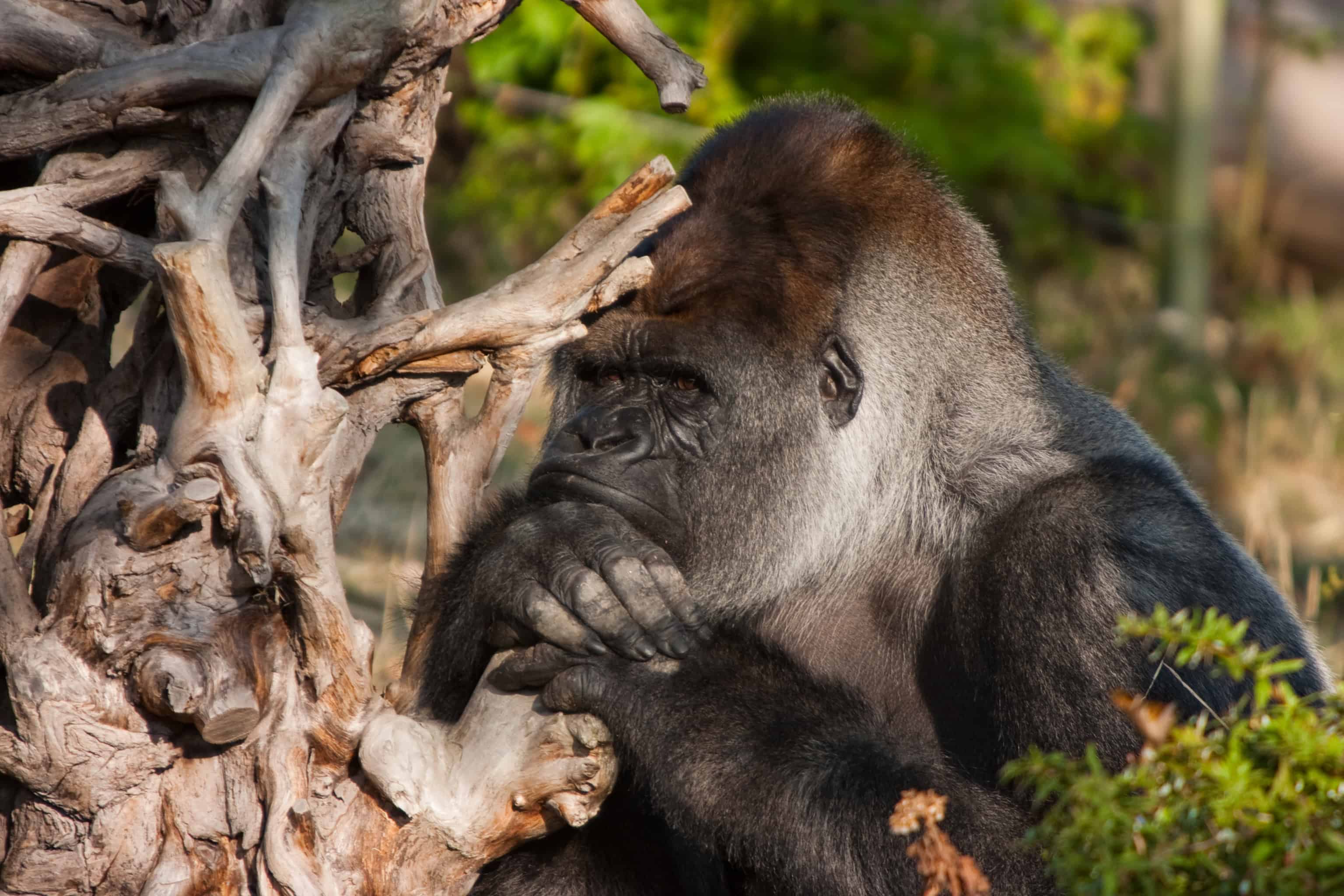 Bokito is thinking. 26 September, 2009. Photo: Sander van der Wel
A father, a family leader and a familiar face
As the years passed, Bokito became one of the central figures in Blijdorp's gorilla group. He fathered ten offspring and developed into what the zoo described as a social family man. Rather than simply dominating the other animals through physical strength, he provided stability and maintained order within his group.
This role was especially significant because gorilla societies are built around relationships. A silverback often acts as the central figure around whom females and younger animals organise their lives. His presence can help prevent disputes from escalating, provide reassurance to younger gorillas and maintain a predictable social environment.
Bokito was also known for accepting a young gorilla named Nasibu as a foster son, behaviour that Blijdorp considered particularly unusual.
The contrast with his international reputation was striking.
To a casual observer who remembered the terrifying images of 2007, Bokito might still have represented danger. To the people who watched him over the years, he was also an attentive family leader whose presence helped keep the group together.
When Bokito died in 2023, Bart Noordegraaf, then vice-chairman of the Friends of Blijdorp association, reflected on precisely this difference. He described the gorilla as an icon and emphasised the gentler qualities that visitors might not have expected from the animal they knew through news reports.
The zoo itself repeatedly highlighted his contribution to the welfare and stability of the group. For Rotterdam residents, Bokito's enduring appeal was also connected to familiarity. Blijdorp is one of the city's most established institutions, a place where generations of families have watched animals grow, change and sometimes raise families of their own. The life of a long-term resident such as Bokito could become intertwined with the memories of the people who visited him.
A child who first encountered Bokito shortly after his arrival in Rotterdam in 2005 might have returned as an adult with children of their own. Over nearly eighteen years, visitors could watch him grow older, become a father and assume his place within the gorilla group. That continuity is difficult to capture in a news headline, but it helps explain why his death affected so many people.
Do you run a business? RotterdamStyle is looking for a main sponsor. Get exclusive visibility across our website for a fixed fee. Interested? Contact us 🤝
An unexpected farewell
On 4 April 2023, Bokito died unexpectedly at the age of 27. He had been unwell for several days, prompting Blijdorp's veterinary team to monitor him closely and investigate his symptoms. When his condition failed to improve, the decision was made to examine him under anaesthesia and administer fluids.
He died during the procedure.
A post-mortem examination subsequently established heart failure as the cause of death. His heart was sent for further scientific investigation in England. At 27, Bokito was relatively young for a gorilla in captivity, where individuals can sometimes live well into their forties or beyond.
News of his death spread quickly. Once again, Bokito became a national news story, but this time the images and reactions were those of remembrance. For his caretakers, the loss was especially personal. They had spent years observing him, caring for him and learning to understand his behaviour as an individual.
His death also had consequences within the gorilla group. Blijdorp allowed the other gorillas to encounter Bokito's body. As caretaker Victor Ketellapper explained in an interview with RTL Nieuws, the animals approached him, smelled him and touched him before eventually moving away. In the days that followed, the group appeared unsettled. Ketellapper described the animals as unusually quiet and explained that Bokito's absence had disrupted the social order they had known.
Whether gorillas experience grief in the same way humans do remains difficult to establish scientifically. Researchers have documented responses to death among several highly social animal species, but interpreting those responses requires caution.
What was clear in Rotterdam was that Bokito had occupied an important position in his group, and that his absence changed its dynamics. The powerful silverback who had once made international headlines for crossing the boundary between animals and visitors was gone. And the gorillas he left behind would have to adjust to a life without their leader.
Do you run a business? RotterdamStyle is looking for a main sponsor. Get exclusive visibility across our website for a fixed fee. Interested? Contact us 🤝
How do you remember a Rotterdam icon?
Following his death, the question of how Rotterdam should honour Bokito quickly entered public discussion.
In April 2023, political party Leefbaar Rotterdam proposed erecting a statue in his memory. Supporters argued that Bokito had become one of the city's best-known inhabitants and deserved a permanent tribute. Others questioned whether a statue was appropriate, particularly given the circumstances that had originally made him famous. The proposal failed to secure a majority in the Rotterdam municipal council.
Blijdorp's management suggested another way of honouring the gorilla. Instead of focusing entirely on a physical monument, zoo director Erik Zevenbergen encouraged people to consider supporting conservation efforts that could benefit Bokito's relatives in the wild. It was a perspective that connected the affection people felt for one individual animal with a much larger problem.
Bokito was a western lowland gorilla, a subspecies facing severe threats in its natural habitat in Central Africa. Habitat destruction, poaching and disease have placed enormous pressure on wild populations. Although he had lived his entire life in captivity, Bokito belonged to a species whose long-term survival cannot be taken for granted. His story therefore raises a broader question about the role of modern zoos. Beyond displaying animals, zoological institutions increasingly place emphasis on population management, research, conservation and public education. A famous individual such as Bokito can attract public interest in an entire species. But the ultimate value of that attention depends on what people learn and what it inspires them to protect.
Blijdorp eventually chose a form of remembrance that combines scientific research with preservation.
In January 2024, the zoo announced that Bokito's body would be made available for extensive research into the anatomy of great apes, followed by preservation at the Natuurhistorisch Museum Rotterdam. Researchers led by Professor Evie Vereecke at KU Leuven in Belgium began studying his musculoskeletal system. With Bokito weighing approximately 220 kilograms at the time of his death, obtaining detailed images of his body required specialised equipment.
Working with Ghent University, the researchers used a scanner large enough for horses to create detailed images of his skeleton. A digital three-dimensional model was subsequently developed, allowing scientists to study his anatomy without repeatedly handling the original remains. Particular attention was given to his shoulders, muscles and joints. Differences between the anatomy of gorillas, chimpanzees, bonobos and more tree-dwelling great apes can help scientists understand how movement has shaped the bodies of different primate species. The research may also provide insights into aspects of human anatomy, including the development and function of our own shoulders.
In this sense, Bokito continues to contribute to science even after his death. The plan is for his preserved skin and skeleton to become part of the permanent collection of the Natuurhistorisch Museum Rotterdam after the scientific work is completed. However, that does not mean visitors will immediately be able to see him.
Blijdorp and the museum agreed that Bokito should remain out of public view for at least ten years, rather than becoming an attraction simply because of his fame. It was a deliberate decision to give him what the institutions described as a dignified farewell. You can read more about the project through Diergaarde Blijdorp and the Natuurhistorisch Museum Rotterdam.
Do you run a business? RotterdamStyle is looking for a main sponsor. Get exclusive visibility across our website for a fixed fee. Interested? Contact us 🤝
The end of an era at Blijdorp
Bokito's death marked more than the loss of one famous animal. It eventually contributed to a major change in the future of gorillas at Rotterdam Zoo. Without their established silverback, the original group faced an uncertain future. Introducing an unfamiliar adult male could carry significant risks, particularly for offspring fathered by Bokito.
In November 2023, Blijdorp announced that it would gradually relocate its existing gorillas to other European zoos. The decision also reflected a broader change in the zoo's conservation priorities and plans to restore parts of the historic Rivièrahal. In April 2026, the last three members of the former Rotterdam group, Aya, Ayba and Ajabu, left for Frankfurt Zoo, where they could join a family with an established silverback.
With their departure, the group that had formed such an important part of Bokito's life disappeared from Rotterdam.
Gorillas did not vanish from Blijdorp altogether, however. In 2026, the zoo welcomed a different group on a temporary basis, including silverback Shomari and three females, Gasira, Uzuri and Makeba. According to Blijdorp's announcement, the arrangement allows Rotterdam to provide temporary accommodation for gorillas within the European population management programme while the zoo prepares for future renovations. Visitors can therefore still encounter gorillas in Rotterdam. But the family that Bokito once led is no longer there.
It is a quiet but significant ending to a chapter of Blijdorp's history.
For all the attention surrounding his escape, Bokito spent most of his Rotterdam life doing something far less dramatic: living among other gorillas, raising offspring and maintaining the relationships that mattered within his group. He was never simply a symbol of danger, just as he was never the gentle human-like character that visitors might sometimes have wished him to be. He was a gorilla, with his own instincts, social relationships and individual history. His life offered moments of extraordinary public fascination, but also demonstrated the complexity of the animals with whom humans share so much of their evolutionary past.
The name Bokito will probably always bring to mind that remarkable afternoon in May 2007. It was the day he became famous and the reason his name entered the Dutch language.
Yet fame is rarely the whole measure of a life.
For the people who cared for him, the visitors who watched him grow older and the city that came to regard him as one of its own, Bokito's story stretches far beyond a single afternoon. It began in Berlin, continued for almost eighteen years in Rotterdam and now lives on in the memories of visitors, the descendants he left behind and the scientific knowledge his body may help uncover.
Bokito became world-famous for escaping his enclosure. But it was the life he lived in Rotterdam that made him part of the city.