
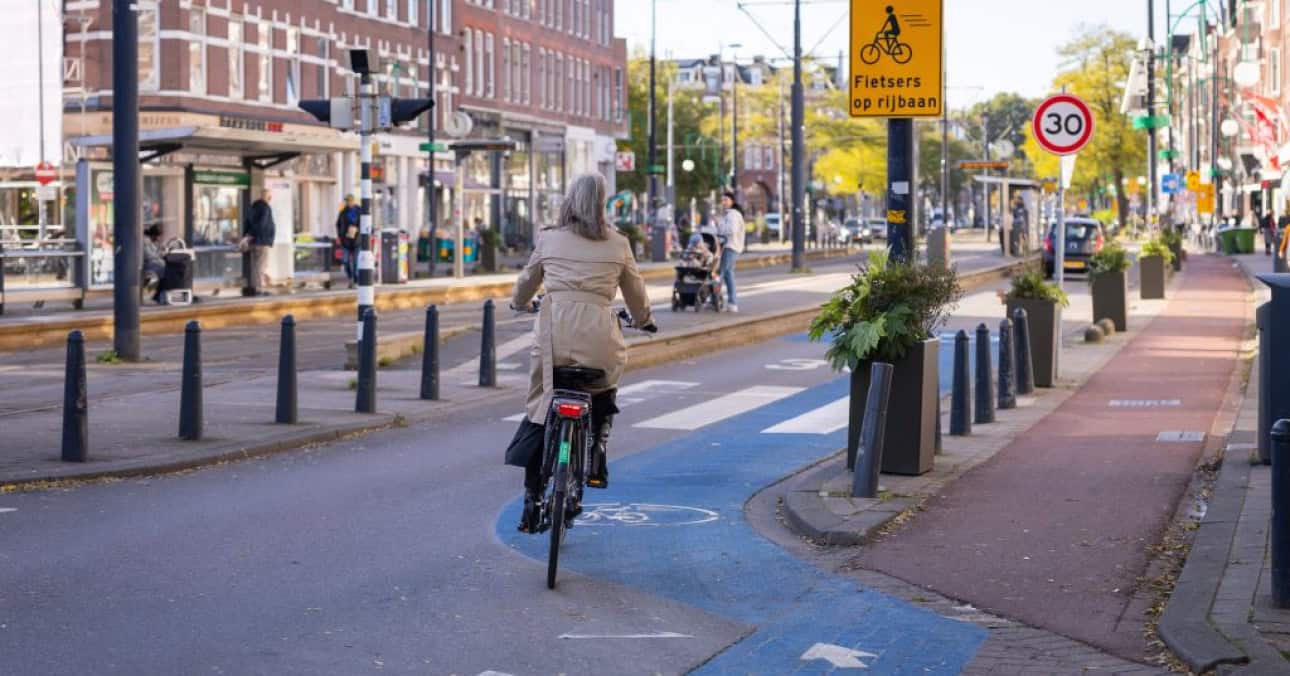
Rotterdam has launched an unusual cycling experiment in Delfshaven. From 2 November 2026 until the end of March 2027, cyclists travelling faster than 20 km/h can choose to leave the cycle path and ride on the road alongside cars on designated sections of the 1e and 2e Middellandstraat. The city hopes the trial will make its narrow cycle paths safer, although some residents are concerned about the risks of mixing cyclists with motor traffic.
Image: Blue road markings and temporary signs indicate where faster cyclists may enter the carriageway. Photo: Rhalda Jansen / Municipality of Rotterdam.
The experiment follows a request from the Middelland-Nieuwe Westen neighbourhood council, which raised concerns about cycling safety in the area. The separated cycle paths along Middellandstraat are narrow in places, leaving limited room for overtaking.
With conventional bicycles, e-bikes, fatbikes and other users travelling at different speeds, overtaking can become uncomfortable and sometimes dangerous. Rotterdam's proposed solution is to give faster riders the option of using the road, freeing up space for people cycling at a more leisurely pace.
Do you run a business? RotterdamStyle is looking for a main sponsor. Get exclusive visibility across our website for a fixed fee. Interested? Contact us 🤝
Where can faster cyclists use the road?
The trial applies to two sections of the 1e and 2e Middellandstraat:
- Between Van der Poelstraat and Jan Sonjéstraat, travelling from west to east.
- Between Duivenvoordestraat and Aleidisstraat, travelling from east to west.
Cyclists who travel faster than 20 km/h can choose between the existing cycle path and the road on these stretches. The measure is optional, meaning faster cyclists are not required to ride among cars.
The arrangement also applies to e-bike and fatbike riders, road cyclists, light moped riders and users of approved light electric vehicles, such as legally permitted electric scooters, provided they meet the trial's speed criteria.
Temporary traffic signs and blue road markings indicate where cyclists can move onto the carriageway. The markings are intended to make the new arrangement clear to both cyclists and motorists.
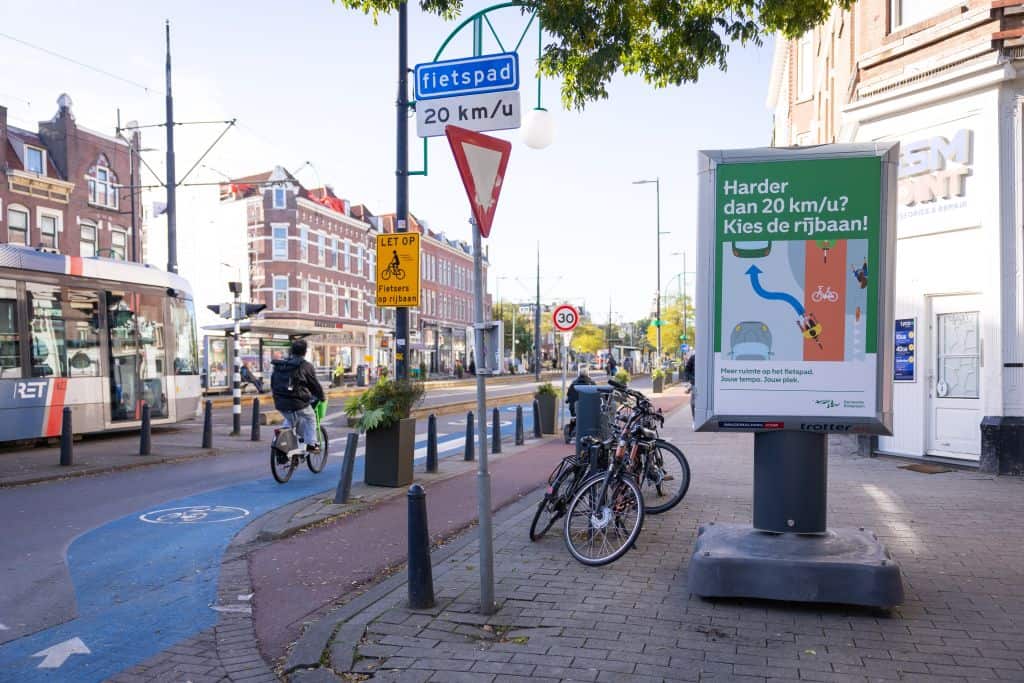 Blue road markings and temporary signs indicate where faster cyclists may enter the carriageway. Photo: Rhalda Jansen / Municipality of Rotterdam.
Why Rotterdam is experimenting with mixed traffic
The maximum speed on the 1e and 2e Middellandstraat was previously reduced to 30 km/h. According to the municipality, this lower speed limit makes it possible to experiment with cyclists and motor vehicles using the same road space.
Chantal Zeegers, Rotterdam's alderwoman responsible for mobility, says the city wants to encourage more people to cycle while improving safety for existing cyclists.
Widening cycle paths and redesigning streets can be expensive, time-consuming or physically difficult. The municipality therefore sees the Middellandstraat experiment as a possible alternative to major reconstruction.
The idea is that faster cyclists will have more room to travel at their preferred speed, while slower riders can use the cycle path without constantly having to accommodate overtaking traffic.
Do you run a business? RotterdamStyle is looking for a main sponsor. Get exclusive visibility across our website for a fixed fee. Interested? Contact us 🤝
Not everyone is convinced
Whether moving faster cyclists onto the road will actually make the street safer remains to be seen.
Local broadcaster OPEN Rotterdam has reported mixed reactions from residents. Some are concerned about cyclists sharing the road with cars, while others question whether motorists consistently observe the 30 km/h speed limit.
These concerns highlight an important distinction: reducing congestion on the cycle path does not automatically mean the street as a whole becomes safer. The experiment will need to demonstrate whether the arrangement improves conditions without creating new risks elsewhere.
What happens after March 2027?
The trial is scheduled to continue until the end of March 2027. Afterwards, Rotterdam will evaluate the results, including the experiences of residents and road users.
The municipality will assess whether the arrangement has made cycling safer and more comfortable on Middellandstraat before deciding what happens next.
For now, the blue markings offer cyclists a new choice on one of Rotterdam-West's busy streets. Whether the experiment becomes a model for other roads will depend on what happens when bicycles and cars begin sharing the space.
More information is available on the municipality of Rotterdam's official website.