

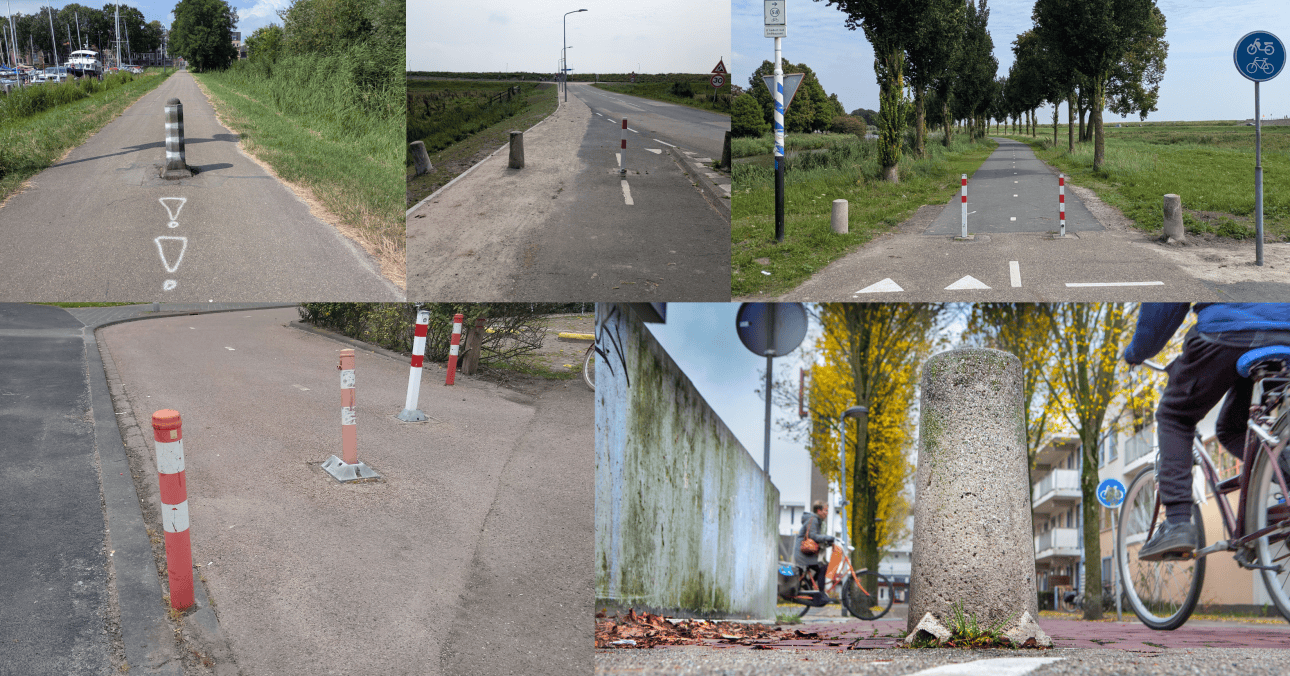
ROTTERDAM, 9 September 2026 – Cyclists in Rotterdam and across the Netherlands are being asked to help map bollards on cycle paths during a national bike-path bollard check day, known in Dutch as Paaltjescheckdag. The Fietsersbond and engineering consultancy Haskoning are organising the initiative on Saturday 19 September to identify bollards that may be dangerous, unnecessary or missing from existing records.
Bollards can create cycling hazards
Bollards are commonly placed on cycle paths to prevent cars and other motor vehicles from entering them, but they can also become obstacles for cyclists. Poor visibility, unsuitable placement or limited space around a bollard can contribute to collisions.
According to the Fietsersbond, thousands of cyclists are injured each year after colliding with bollards, amounting to more than six injured cyclists per day. The organisation says the problem can be particularly serious for less agile cyclists and people using adapted bicycles, which are often wider than conventional bikes.
“A bollard can suddenly appear in your path on a busy cycle route,” says Jaap Kamminga, policy adviser at the Fietsersbond. “It can be particularly difficult for less agile cyclists and people with an adapted, often wider, bicycle to pass safely. A bollard should have a clear purpose and be positioned safely. If that is not the case, we would rather see it removed.”
Do you run a business? RotterdamStyle is looking for a main sponsor. Get exclusive visibility across our website for a fixed fee. Interested? Contact us 🤝
How Paaltjescheckdag works
During Paaltjescheckdag on 19 September, you can check an online map showing known bollards and help determine whether they are still there. You can also report bollards that are currently missing from the database.
Participation does not require a special organised ride. You can check the map from home or take your bike out around Rotterdam and compare the information with what you encounter along local cycle routes.
The Fietsersbond has already mapped many bollards with the help of cyclists in previous years, but the network keeps changing. Existing bollards can be moved or removed, while new ones may appear elsewhere.
You can access the map and information about taking part via fietsersbond.nl/paaltjescheckdag.
Updated data can help municipalities
The aim is to create a more accurate picture of where bollards are located and what purpose they serve. This information can then be used by local Fietsersbond volunteers when discussing cycling infrastructure with municipalities.
“Pleasant cycling starts with safe cycle paths. Good design is essential,” says Jacob Tiellemans, who leads Haskoning’s cycling team. “That is why it is important to know exactly where bollards are located and what their function is. With Paaltjescheckdag, we are mapping that information together with cyclists. Municipalities can then use it to make their cycle paths safer.”
The municipality of Tilburg is cited by the organisers as one example of a local authority examining whether unnecessary bollards can be removed. The wider initiative applies nationwide, meaning observations made on Rotterdam’s extensive cycle network can also be added to the database.
Do you run a business? RotterdamStyle is looking for a main sponsor. Get exclusive visibility across our website for a fixed fee. Interested? Contact us 🤝
How to take part in Rotterdam
Paaltjescheckdag takes place on Saturday 19 September 2026. You can participate from home by checking the online map, or use a cycling trip around Rotterdam to check whether mapped bollards are still present and identify any that have not yet been recorded.
Participation is open to everyone. More information and the online map are available at fietsersbond.nl/paaltjescheckdag.
Date: Saturday 19 September 2026
Activity: Check and report bollards on cycle paths
Participation: Free and open to everyone