
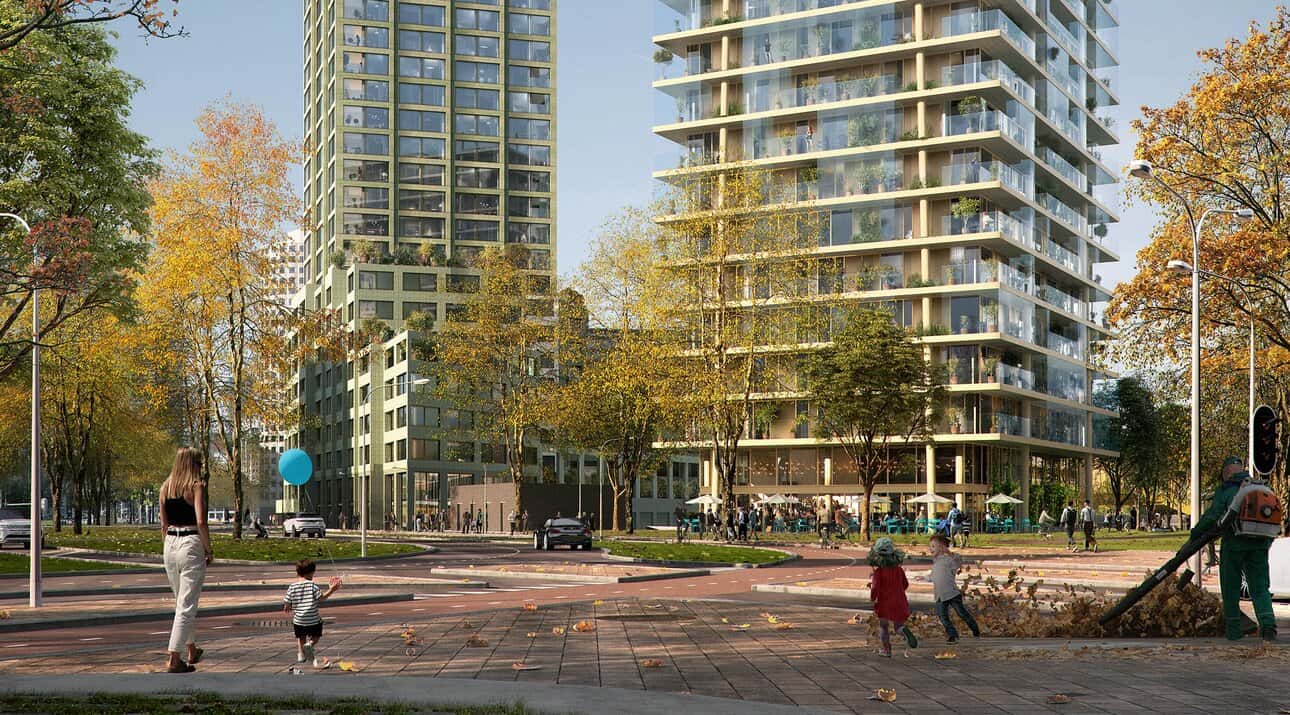
ROTTERDAM, 9 December 2025 – Pompenburg, the area around the former Hofplein station, is set to be rebuilt as a residential and public quarter. The plan aims to reconnect Rotterdam’s old city heart with Rotterdam-Noord through new housing, green space and places to stay rather than pass through.
Image: Aritist impression of Pompemburg Towers. Photo credit: Absent Matter
Pompenburg, currently dominated by traffic and leftover space between roads and rail, will be transformed into a neighbourhood with homes, cafés and a new park. The zoning plan that makes this possible has been submitted by the municipal executive to the city council for approval.
Before the Second World War, Pompenburg formed part of Rotterdam’s lively city centre, with the old Hofpleinlijn station building and cafés such as Loos. The post-war reconstruction never fully restored that role, leaving the area with the feel of a forgotten corner between the inner city and the north. Alderman for climate, building and housing Chantal Zeegers describes Pompenburg as the last section of the bombed city centre still awaiting a full new interpretation and says the city now wants to draw it back into the urban fabric.
The development consists of three residential buildings with four towers, with heights ranging from 57 metres on the Stroveer side to 140 metres at Pompenburg itself. Around 1,100 rental and owner-occupied homes are planned, of which at least 60 percent will be in the social and mid-price segments. This includes 167 social rental homes and roughly 510 homes for middle-income households, adding a substantial number of more affordable addresses close to the centre.
Do you run a business? RotterdamStyle is looking for a main sponsor. Get exclusive visibility across our website for a fixed fee. Interested? Contact us 🤝
Connecting centre and noord
The new Pompenburg is intended to act as a link between the city centre and Rotterdam-Noord rather than a barrier. In addition to housing, the plan allows for a mixed programme of up to 10,400 square metres, including space for hospitality, offices and creative companies. A film house is being considered as a possible addition that could tie into the cultural programme on and around the Hofbogen.
On the site of the former Hofpleinlijn station building, a new contemporary pavilion is planned, with hospitality to draw people into the area at street level. Around and between the buildings, a park-like landscape with different atmospheres will be created, connecting to surrounding districts and offering informal routes between the centre, the Agniesebuurt and the Oude Noorden.
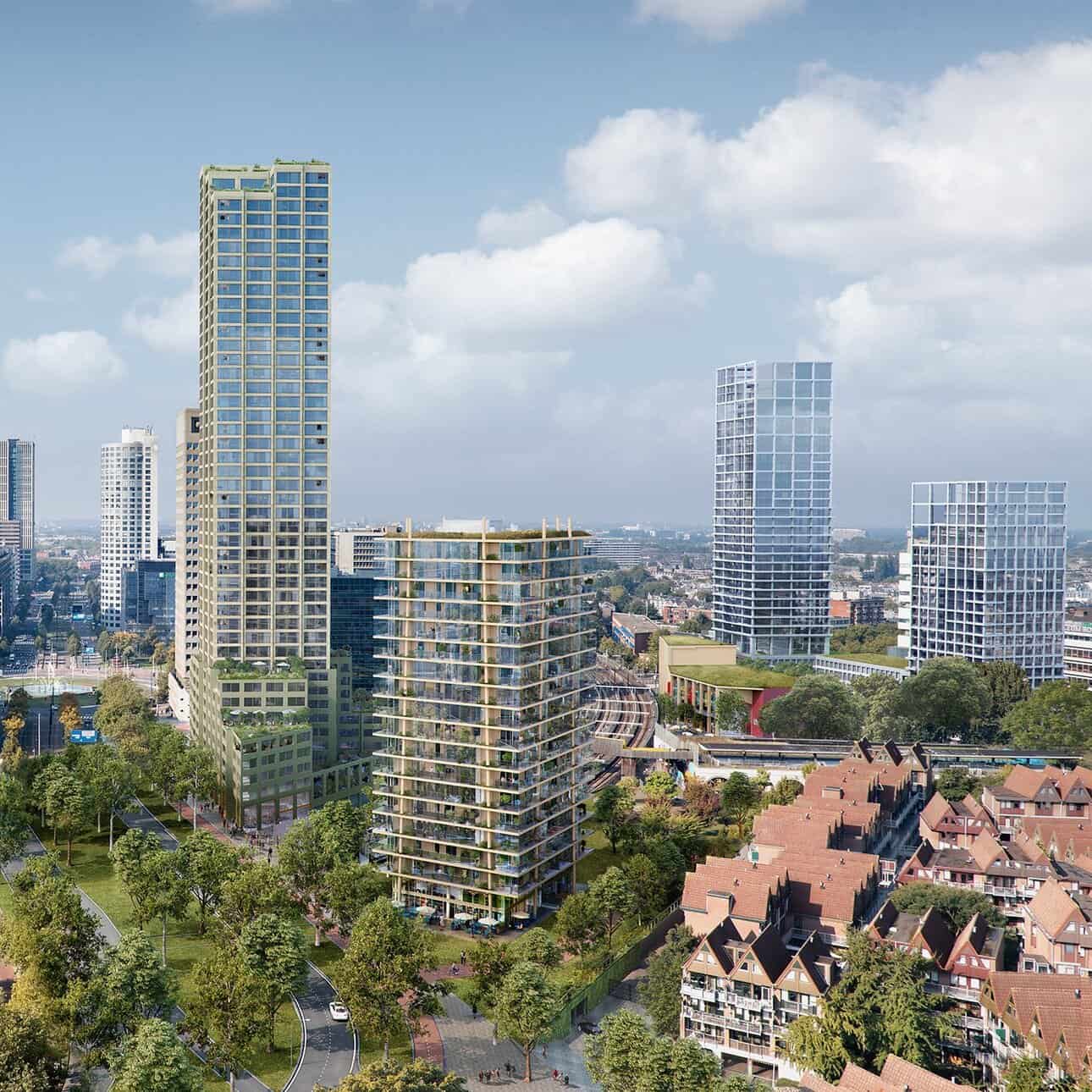 Image: Artist impression of Pompenburg Towers. Photo credit: Absent Matter
Staying rather than passing through
In the future layout, cars are described as guests in the area. New walking and cycling paths will link up with existing routes, including connections towards the Hofbogen and the green strips along the former elevated railway. The ambition is to make Pompenburg a place where people live, meet and linger, rather than a traffic corridor dominated by through-traffic.
The public space will include different types of greenery, from planted squares around the towers to quieter park sections along the edges. By combining homes, workplaces and public functions at ground floor level, the city hopes to bring back the day and evening life that once characterised this part of Rotterdam.
Collaboration and planning process
The development is being prepared by a consortium of Dura Vermeer, J.P. van Eesteren and Synchroon, working in partnership with the municipality of Rotterdam. From their shared area vision “Verbinden door verblijven” (connecting by staying), the parties want to shape Pompenburg as both a residential location and a destination for visitors.
Residents and other stakeholders have already had the opportunity to respond to the draft zoning plan. Those who submitted views will be invited to a hearing in January 2026. The municipal council is expected to decide on the plan in February 2026. If procedures progress as planned, construction is scheduled to start at the end of 2027.
Do you run a business? RotterdamStyle is looking for a main sponsor. Get exclusive visibility across our website for a fixed fee. Interested? Contact us 🤝
How to get to Pompenburg
Pompenburg lies just north of the city centre, between Hofplein, the Delftseplein rail tracks and the access roads towards Rotterdam-Noord. The area sits on the edge of the districts Oude Westen and Agniesebuurt, within walking distance of Rotterdam Centraal and the Coolsingel.
From Rotterdam Centraal, Pompenburg can be reached on foot in a few minutes via Stationssingel and Pompenburg, or by tram to Hofplein and then a short walk. Cyclists use the main routes that run from the centre towards the Hofbogen and the Schiekade, passing directly along the development site.