
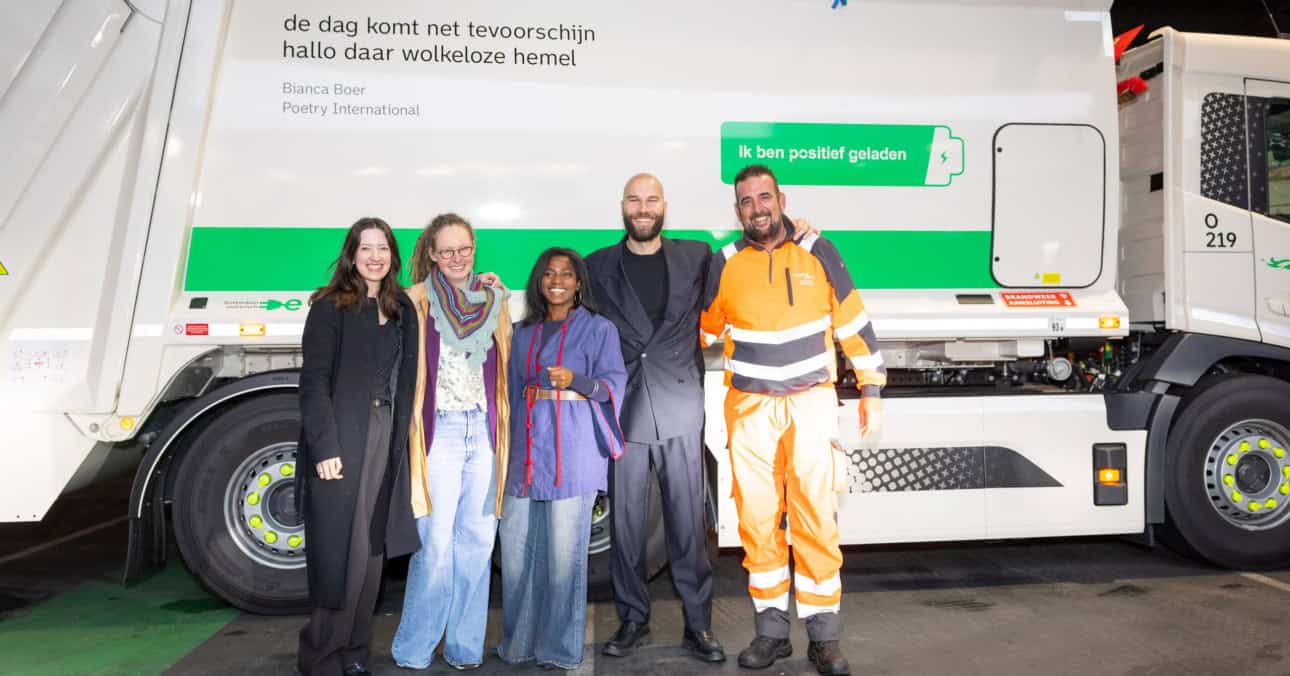
ROTTERDAM, 14 October 2026 – The lines of poetry that have travelled through Rotterdam on municipal rubbish trucks and street sweepers since 1988 have been added to the Dutch Inventory of Intangible Cultural Heritage. The recognition celebrates an unusual Rotterdam tradition that brings poetry into everyday streets while also putting the people who keep the city clean in the spotlight.
Image: Poetry International director Diana Chin-A-Fat, poet Bianca Boer, alderman Joan Nunnely, collection manager Thomas van Brakel and rubbish truck driver Niels Bruinsel mark the recognition of Rotterdam's rubbish truck poetry as Dutch intangible cultural heritage. Photo: Rhalda Jansen.
Poetry that travels through the city
It is an unlikely combination: poetry and municipal waste collection. In Rotterdam, however, the two have shared the road for almost four decades.
The tradition began in 1988 with the idea of keeping something from the annual Poetry International Festival visible in Rotterdam after visiting poets had gone home. Rather than confining their work to books or festival stages, lines of poetry were placed on the large sides of rubbish trucks, allowing them to move through neighbourhoods every day.
The project was initiated by Hans Abelman with support from then Poetry International director Martin Mooij and Roteb director Huub Kros.
Since then, hundreds of lines by Rotterdam, Dutch and international poets have appeared on municipal refuse trucks and street-cleaning vehicles.
The practice has now been formally included in the Dutch Inventory of Intangible Cultural Heritage, recognising the living tradition behind the poems rather than the vehicles themselves.
Do you run a business? RotterdamStyle is looking for a main sponsor. Get exclusive visibility across our website for a fixed fee. Interested? Contact us 🤝
How the poems get onto the trucks
The process has remained surprisingly simple.
When Rotterdam's municipal cleaning service expects new rubbish trucks or street sweepers, Poetry International is notified. The organisation then selects lines of poetry that will be applied to the vehicles.
That has created an ever-changing collection travelling through Rotterdam, sometimes encountered while crossing the street or waiting for a truck to finish its work.
This year brought another first when a line of poetry in Dutch Sign Language appeared on a rubbish truck, adding an officially recognised Dutch language to the project and making sign-language poetry more visible in public space.
The concept has even travelled abroad. Frankfurt adopted a similar project in 2016 under the name Müll & Poesie, bringing poetry onto municipal cleaning vehicles in Germany.
Jules Deelder gave the project its name
One line has a special status within the Rotterdam project.
In 1988, city poet Jules Deelder contributed Het gedicht is een bericht, meaning “The poem is a message”. The line gave the project its name and remains the only poem that returns every year on one of Rotterdam's rubbish trucks.
That continuity has helped turn what started as an experiment into a recognisable feature of the city's streetscape.
Poetry International director Diana Chin-A-Fat describes the strength of the project as its quiet presence:
“What I personally find so wonderful about Het gedicht is een bericht is that it is not a loud statement, but a quiet, consistent presence of poetry in the city. The lines invite you to look, read and think, and that is precisely how they catch your attention. The project also makes visible what will always drive us as an organisation: our love of poetry.”
Do you run a business? RotterdamStyle is looking for a main sponsor. Get exclusive visibility across our website for a fixed fee. Interested? Contact us 🤝
A tribute to poetry and city cleaners
The new heritage status also acknowledges the municipal workers who take the poems through Rotterdam as part of their daily work.
Rotterdam alderman for Culture, Events, Community and Language Joan Nunnely said the unexpected encounter between daily life and literature is precisely what gives the project its power.
“You are waiting for the rubbish truck to pass and read a sentence that stays with you for the rest of the day. That is what I find so powerful about this project: poetry simply out on the street. Our cleaning crews and Poetry International have kept this special tradition alive for almost forty years. This recognition is also a compliment to them.”
Thomas van Brakel, manager of waste collection, also sees an obvious connection between the practical work of cleaning the city and the beauty carried on the trucks.
“What is rubbish to one person is art to another. Poetry is beauty, and we try to bring beauty to Rotterdam. We clean the city and add a little beauty at the same time.”
Rubbish truck driver and poet Paul Keijzer put it more simply:
“We live in a busy world, and when you read a little poetry, you calm down.”
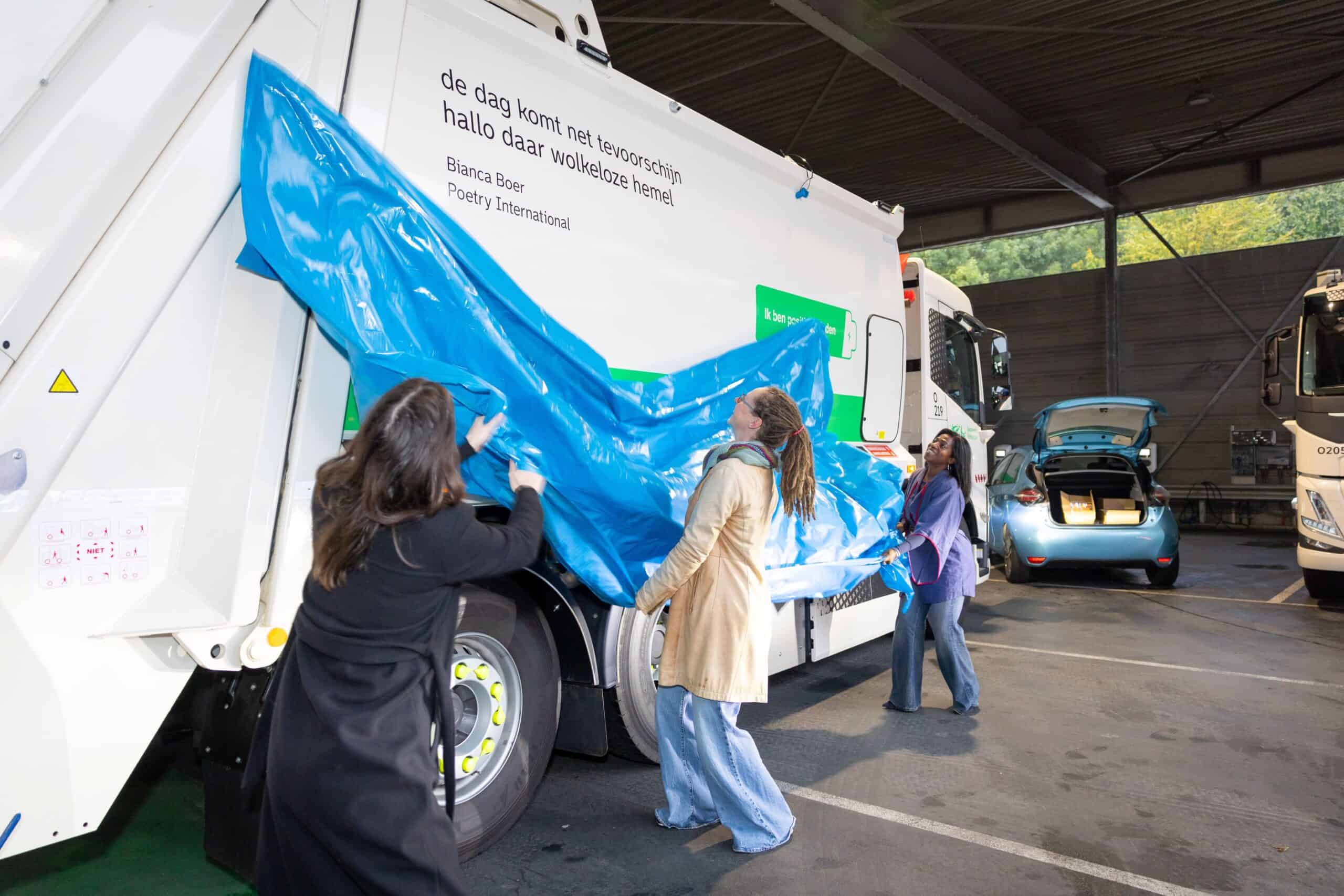 Alderman Joan Nunnely and Poetry International director Diana Chin-A-Fat unveil a line by poet Bianca Boer on a Rotterdam rubbish truck. Photo: Rhalda Jansen.
When a rubbish truck becomes literary recognition
The trucks have become such a familiar part of Rotterdam's literary landscape that appearing on one can feel like a peculiar local badge of honour.
Rotterdam resident Jaap Kes describes how seeing a poet's work on a municipal vehicle can change the way that poet is perceived.
“My neighbour was a city poet. But I have to admit that, to me, his status as a poet was only definitively established when I saw one of his poems drive past on a rubbish truck.”
Rotterdam poet Derek Otte is among the writers whose words have travelled through the city. Two of his lines read:
Van stenen gaat een stad de hoogte in,
de mensen geven diepte
Loosely translated: a city rises through its stones, but its people give it depth.
With the tradition now recognised as Dutch intangible cultural heritage, Rotterdam's moving collection of poetry is set to remain part of everyday city life.



.jpg)