
12 AUGUST 2026 | Rotterdam experienced its deepest partial solar eclipse since 1999 on Wednesday 12 August. At maximum at around 20:11, the Moon covered almost 89% of the Sun’s visible surface, leaving a narrow crescent low above the west-northwestern horizon. This page is now an archive of the event, including the local timings, viewing advice and solar-safety guidance.
Rotterdam remained outside the path of totality, so the city did not become completely dark. The eclipse was nevertheless clearly visible locally. Photographs captured the solar crescent above the Rotterdam skyline, while local reporting described crowds watching from the Euromast and Wilhelminakade.
Eclipse times in Rotterdam
The partial eclipse began in Rotterdam at approximately 19:16, reached maximum at about 20:11 and ended at around 21:03. The complete local event lasted roughly one hour and 47 minutes.
At maximum, the Sun was about eight degrees above the west-northwestern horizon. The local eclipse magnitude was approximately 0.904, while about 88.7% of the visible solar surface was obscured.
| Detail | Rotterdam, 12 August 2026 |
|---|---|
| Partial eclipse began | approximately 19:16 CEST |
| Maximum eclipse | approximately 20:11 CEST |
| Solar surface obscured | about 88.7% |
| Eclipse magnitude | about 0.904 |
| Partial eclipse ended | approximately 21:03 CEST |
| Viewing direction | west to northwest |
| Sun altitude at maximum | about 8° |
Do you run a business? RotterdamStyle is looking for a main sponsor. Get exclusive visibility across our website for a fixed fee. Interested? Contact us 🤝
What the eclipse looked like
From Rotterdam, the Moon covered most of the Sun while leaving a thin curved strip of sunlight visible around maximum eclipse. Daylight dimmed noticeably, but the city did not experience the darkness associated with totality.
The total phase followed a narrow path across parts of northern Russia, Greenland, Iceland, Spain and a small part of Portugal. Rotterdam remained outside that path, so the Sun’s outer atmosphere, known as the corona, did not become visible and there was no safe naked-eye phase.
Where people could watch in Rotterdam
Because the Sun was only about eight degrees above the horizon at maximum, an unobstructed view towards the west and northwest was especially important. Hoek van Holland beach, open waterfront locations, Dakpark and places around the eastern side of Kralingse Plas were among the locations with potentially useful sightlines.
On the evening itself, local reporting documented spectators at the Euromast and several hundred people around Wilhelminakade. The eclipse was reported to have been clearly visible from the city.
Do you run a business? RotterdamStyle is looking for a main sponsor. Get exclusive visibility across our website for a fixed fee. Interested? Contact us 🤝
How to watch a partial solar eclipse safely
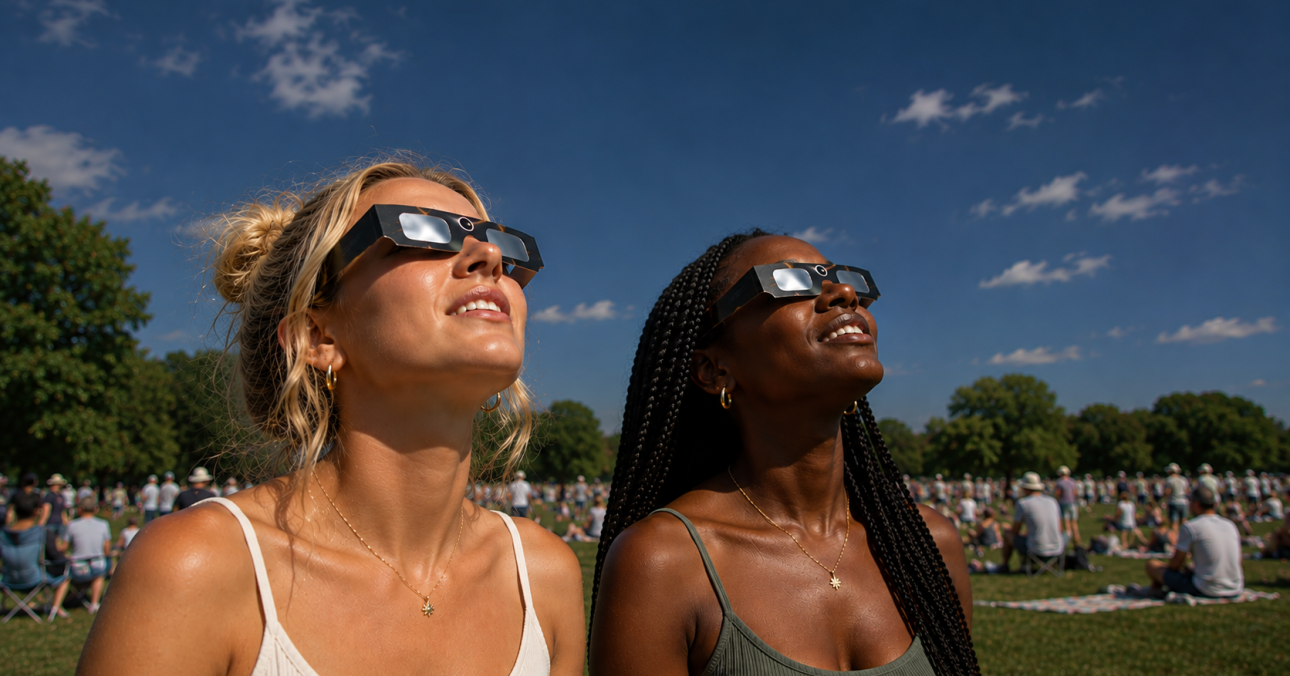
The same safety rules apply whenever you view a partial solar eclipse. Never look directly at the Sun without suitable solar-viewing protection. Eclipse glasses or handheld viewers should comply with ISO 12312-2 and should be checked for scratches, tears or other damage before use. Ordinary sunglasses are not safe for direct solar viewing.
Do not look through binoculars, telescopes or camera lenses while wearing eclipse glasses. Optical equipment concentrates sunlight and requires a purpose-made solar filter mounted securely over the front of the optics.
Safe indirect alternatives include pinhole projection. A colander or gaps between leaves can also project crescent-shaped images of a partially eclipsed Sun onto a nearby surface.
Rotterdam’s biggest eclipse in decades
The 12 August 2026 eclipse was the largest partial solar eclipse visible from the Netherlands since 11 August 1999. Smaller partial eclipses occurred in between, including in March 2025, but none obscured as much of the Sun.
According to the Royal Netherlands Association for Meteorology and Astronomy, KNVWS, the Netherlands will not see another partial solar eclipse of comparable depth until 2081.
The eclipse also coincided with an unusually strong night for skywatching. The Perseid meteor shower peaked later on 12 August into the early hours of 13 August, while a new Moon kept natural skyglow to a minimum.
Read our complete Perseid viewing guide.
Do you run a business? RotterdamStyle is looking for a main sponsor. Get exclusive visibility across our website for a fixed fee. Interested? Contact us 🤝
When is the next solar eclipse in Rotterdam?
The next solar eclipse visible from Rotterdam will occur on 2 August 2027. It will be a considerably smaller partial eclipse locally, with about 40% of the Sun’s surface obscured at maximum.