
HAPPENING 18 SEP 2027 | After an eighteen-year absence, one of Rotterdam's most legendary street parties is coming back. The Rotterdam Dance Parade will return on Saturday 18 September 2027, bringing twenty DJ trucks, thousands of dance music fans and five hours of electronic music to the city's streets. The event will be free to attend, reviving a tradition that helped define Rotterdam's dance culture between 1997 and 2009.
For an entire generation of Rotterdammers, the Dance Parade was an essential part of summer. Huge sound systems rolled through the city centre, DJs played everything from house and trance to techno, and crowds followed their favourite trucks through streets transformed into an open-air dance floor. Its disappearance in 2010 left a gap in Rotterdam's festival calendar that repeated attempts to revive the event failed to fill.
Now, with the Rotterdam Dance Parade officially included in the city's 2027 events calendar, that long wait is finally coming to an end. But what exactly is returning, why did the parade disappear, and what can visitors expect from its comeback?
Rotterdam Dance Parade 2027: dates and details
The organisers have confirmed the following information for the comeback edition:
- Date: Saturday 18 September 2027
- Time: 14:00 to 19:00
- Location: Rotterdam city centre
- Admission: Free
- Parade: Twenty trucks carrying DJs and sound systems
- Route length: Approximately 4.5 kilometres
- Music: Electronic dance music, including house, techno and trance
- Afterparties: Planned at various locations across Rotterdam
Organiser JMR Event Makers expects approximately 400,000 visitors. That is an attendance forecast rather than a confirmed figure, but it gives some indication of the scale being planned. The event is being developed in cooperation with Rotterdam Festivals and the municipality.
The confirmed participating organisations include Loveland, Boothstock, Toffler, A State of Trance and Rotterdam Rave. Local reporting has also identified Armada Music and Audio Obscura among the participants. The individual DJ line-up has not yet been announced.
Do you run a business? RotterdamStyle is looking for a main sponsor. Get exclusive visibility across our website for a fixed fee. Interested? Contact us 🤝
From Berlin's Love Parade to Rotterdam's own dance institution
To understand why the Dance Parade's return matters, we need to go back to the 1990s, when electronic dance music was moving from underground clubs into the cultural mainstream.
Berlin's Love Parade, launched in 1989, demonstrated how electronic music could bring enormous crowds together in public spaces. Its combination of mobile sound systems, DJs and dancing in the streets inspired similar events elsewhere in Europe, including Rotterdam's own Fast Forward Dance Parade.
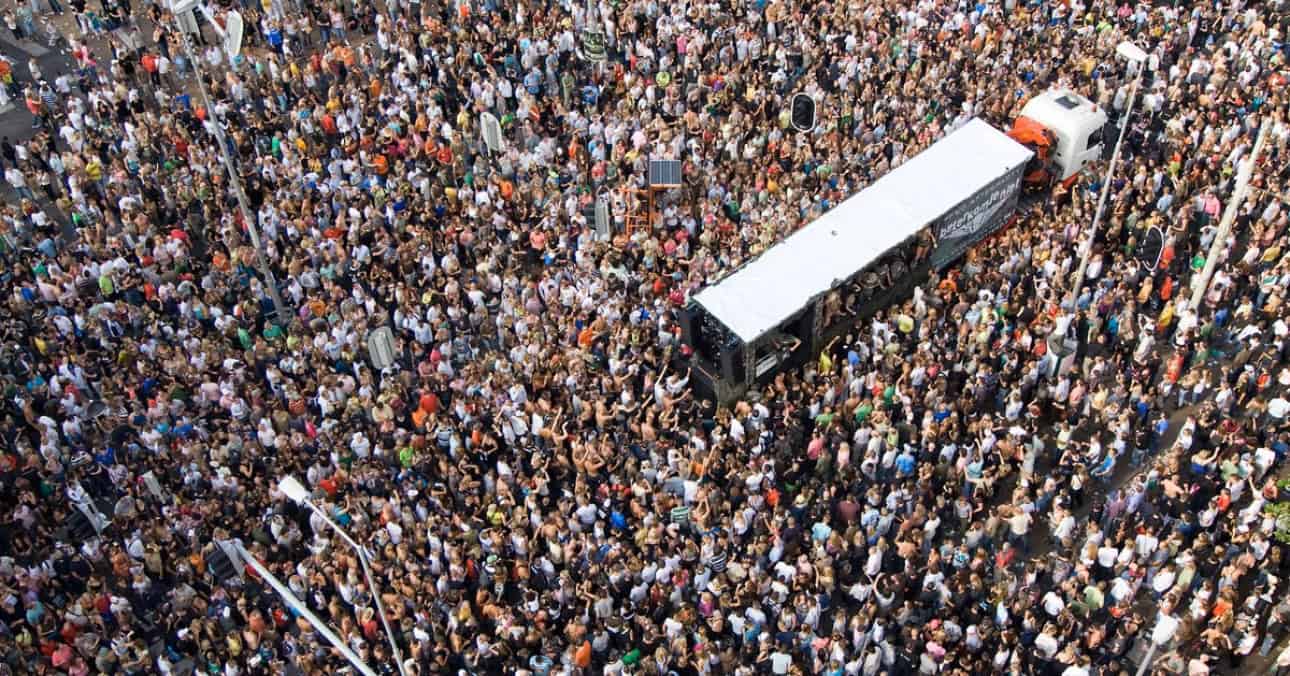
The first Rotterdam edition took place in 1997. Over the following years, it developed into one of the Netherlands' largest free dance events, attracting hundreds of thousands of visitors from the Netherlands and abroad. At its peak, the parade featured roughly forty music trucks, each bringing its own interpretation of electronic dance culture to the streets.
Major names associated with previous editions include Tiësto, Armin van Buuren, Ferry Corsten and Rotterdam DJ Michel de Hey. The combination of established performers, local talent and different dance music styles gave the parade an unusually broad appeal.
Unlike a conventional festival, where visitors gather in front of fixed stages, the Dance Parade brought the music to the audience. You could stand along the route watching one truck after another pass by, or join the moving crowd and follow the sounds you liked best.
That openness was central to its identity. The event took place in the public streets, with no admission fee and no need to buy a festival ticket to experience the music. It gave people who might never have visited a nightclub an opportunity to experience Rotterdam's electronic music culture.
Why did the Rotterdam Dance Parade disappear?
The last edition took place in 2009. Its disappearance was closely connected to a change in Rotterdam's approach to public event safety following serious disturbances at Sunset Grooves, a separate beach festival in Hoek van Holland, later that year.
The violence at Hoek van Holland prompted the municipality, under then-mayor Ahmed Aboutaleb, to introduce stricter requirements for large-scale events. Under the revised policy announced in 2010, the Dance Parade could no longer continue as its familiar free-moving procession through the city centre.
Instead, Rotterdam wanted major dance events to take place on controlled festival grounds, with ticketed admission and additional security arrangements. The organisers considered these requirements too restrictive and financially difficult to accommodate.
Plans for a smaller, paid alternative were developed, but that event was also cancelled, partly because of disappointing advance ticket sales. The original concept, built around free access and music trucks travelling through public streets, had effectively lost the conditions that made it possible.
Importantly, the disturbances that triggered the policy changes had occurred at a different event. The Dance Parade itself was not the festival where the Hoek van Holland violence took place.
Contemporary reporting by NOS in May 2010 documented the organisers' decision and the restrictions that brought the parade to an end.
Do you run a business? RotterdamStyle is looking for a main sponsor. Get exclusive visibility across our website for a fixed fee. Interested? Contact us 🤝
How the comeback became possible
Although the parade disappeared from the calendar, enthusiasm for its return remained. Campaigners, dance music enthusiasts and organisers repeatedly raised the possibility of bringing it back, while discussions about safety, costs and public space continued.
In 2018, Rotterdam residents voted the Dance Parade the city's best festival of all time in a public poll organised around Rotterdam Festivals' 25th anniversary. The result demonstrated that the event retained a special place in local memory, despite having been absent for almost a decade.
Political support also increased. Rotterdam's coalition agreement for 2022 to 2026 included an ambition to investigate whether the parade could return safely. Further research followed, and the organisers continued working towards an acceptable plan.
The breakthrough came in November 2026, when the city confirmed the parade's inclusion in the 2027 events calendar.
Among the people involved in the long-running effort to revive the event is Henk Witteveen, who has worked with JMR Event Makers and other partners to bring the concept back. Their task has been to develop a format that retains the atmosphere of the original parade while meeting the safety expectations of a major contemporary city event.
Rotterdam Festivals director Renske Satijn welcomed the announcement, describing the parade as an event deeply rooted in the city's collective memory. Mayor Carola Schouten has likewise expressed support, while emphasising the importance of safety and cooperation between the organisers and public services.
The comeback is therefore more than a nostalgic reunion. It represents a new agreement about how Rotterdam can accommodate large, free cultural events in its public spaces.
What will be different in 2027?
Although the 2027 edition draws directly on the original concept, it will not be an exact reconstruction of the old Dance Parade.
The most obvious change is the number of trucks. Previous editions accommodated approximately forty, while the comeback will feature twenty. According to the organisers, the vehicles will be spaced further apart, allowing more room for visitors to move between them while maintaining a substantial procession.
There will also be a greater emphasis on the parade itself. Rather than treating the moving trucks primarily as a journey towards a large final festival site, the organisers want the procession to be the main attraction.
The music is expected to reflect both the history of Rotterdam's dance scene and the sounds of a new generation. Established organisations will share the programme with contemporary names, creating an opportunity to connect different generations of electronic music fans.
Afterparties are planned at several venues around the city, allowing the celebrations to continue after the moving parade finishes at 19:00. Specific venues, admission conditions and programmes will be announced separately.
The Rotterdam Dance Parade 2027 route
The planned route covers approximately 4.5 kilometres through central Rotterdam. In an interview with local newspaper De Havenloods, JMR Event Makers representative Jasper Scholte described a procession beginning behind the Cube Houses, continuing along Blaak and Westblaak, turning towards Mathenesserlaan and Nieuwe Binnenweg, and then passing the area around de Doelen before travelling via Weena to Coolsingel.
Under the route described by Scholte, the procession would finish at Churchillplein.
These streets provide an early indication of where the parade is expected to travel, but visitors should treat the itinerary as provisional until the organisers publish a final route map, access information and any crowd-management arrangements.
The map below marks Blaak, one of the streets mentioned in the proposed route. It is not a complete parade route map.
If you are planning to attend, public transport is likely to be the most practical way to reach the city centre. Rotterdam Blaak and Rotterdam Centraal are useful railway stations for different parts of the proposed route, although services and access arrangements may change on the day. Visitors should check the latest public transport notices closer to the event.
Do you run a business? RotterdamStyle is looking for a main sponsor. Get exclusive visibility across our website for a fixed fee. Interested? Contact us 🤝
Do you need tickets for the Dance Parade?
No. The Rotterdam Dance Parade itself is confirmed as a free public event. You will not need to purchase an admission ticket to watch the procession or take part as a member of the public.
However, the planned afterparties are separate events. Their ticketing arrangements and prices have not yet been confirmed, so free admission to the parade should not be taken to mean that every associated party will also be free.
The organisers have also yet to publish full information about accessibility, designated viewing areas, toilets, road closures and other visitor facilities. We recommend checking the official event information before travelling.
You can follow the confirmed event listing through Uitagenda Rotterdam, while Rotterdam Festivals has published the announcement as part of its 2027 calendar.
Two very different Rotterdam street parades
The Dance Parade's return also adds another major public procession to Rotterdam's cultural calendar. The city is already known internationally for its Rotterdam Summer Carnival, which brings Caribbean carnival traditions, elaborate costumes, music and dance into the streets.
Although both events transform public roads into places of celebration, they come from different cultural traditions. Rotterdam Summer Carnival centres on carnival culture and its communities, while the Dance Parade grew out of the electronic music movement and the open-air rave culture of the 1990s.
Together, they reflect the variety of musical influences that have shaped Rotterdam's cultural identity.
A new chapter for Rotterdam's dance culture
There is something particularly fitting about the Dance Parade returning to the streets where it first established itself almost thirty years earlier. Rotterdam has changed considerably since 2009. Its skyline, nightlife, cultural institutions and festival landscape have evolved, and an entire generation has grown up without experiencing the parade.
For people who remember following the trucks through the city, 18 September 2027 offers a chance to revisit an important part of Rotterdam's cultural history. For younger visitors, it will be an opportunity to discover why so many people continued campaigning for the event's return long after its disappearance.
Whether the comeback leads to a permanent annual tradition remains to be seen. For now, one of Rotterdam's most celebrated dance events finally has a date on the calendar again.
We will update this article as the final route, participating DJs, afterparties and practical visitor information are confirmed.