
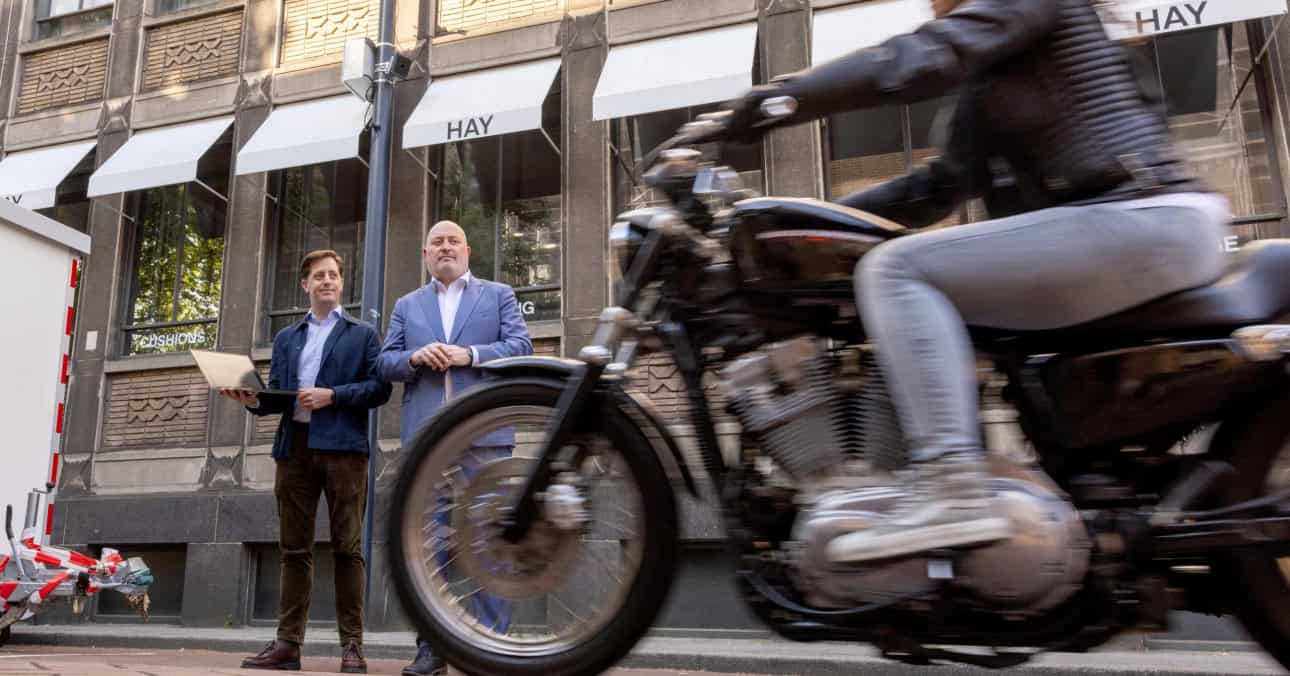
ROTTERDAM, 28 May 2026—Rotterdam has become the first city in the Netherlands to test noise cameras (geluidscamera’s) against loud cars and motorcycles. The pilot starts on Haagseveer and Strevelsweg, where sound equipment is linked to cameras to measure and register traffic noise.
Image: Sorama Business Developer Willem van den Brekel, left, and Alderman Pascal Lansink-Bastemeijer at the launch of the noise camera pilot. Photo: Eric Fecken.
When a passing vehicle exceeds the threshold during the pilot, set at 80 decibels, the camera saves a video of the vehicle. The aim is to see whether Rotterdam can later enforce noise violations faster and more effectively.
Noise cameras target traffic nuisance
Rotterdam receives many complaints about traffic noise and unnecessary noise caused by antisocial road users (verkeersaso’s). The city is using the pilot as part of the Rotterdam traffic nuisance approach (Rotterdamse Verkeersaso Aanpak), a package of measures aimed at reducing antisocial behaviour in traffic.
The problem is appearing more often and in more places across Rotterdam. Loud acceleration, modified exhausts, revving engines and noisy motorcycles are a recurring source of complaints from people living and working in the city.
Do you run a business? RotterdamStyle is looking for a main sponsor. Get exclusive visibility across our website for a fixed fee. Interested? Contact us 🤝
Pilot starts on two streets
The first phase of the pilot takes place on Haagseveer and Strevelsweg. At these locations, the city will test whether the equipment can reliably measure noise and connect that measurement to a passing vehicle.
During the pilot, the noise threshold is set at 80 decibels. The municipality compares that level to the sound of a passing diesel train, a vacuum cleaner or a blender.
Enforcement still needs testing
At the moment, enforcement officers can only issue a fine for unnecessary noise when they catch the offence in the act. That makes enforcement difficult, especially when loud vehicles pass quickly or at unpredictable times.
With noise equipment and licence plate registration, officers would no longer need to be at the exact location at the exact moment. The system could allow them to assess automatic measurements afterwards and decide whether there has been a noise violation.
Do you run a business? RotterdamStyle is looking for a main sponsor. Get exclusive visibility across our website for a fixed fee. Interested? Contact us 🤝
Cameras act as ears
The pilot is mainly meant to test the reliability of the equipment. Rotterdam will assess whether the automatic measurements match what an enforcement officer would have heard and seen on the street.
In practical terms, the city wants to know whether the equipment can act as the eyes and ears of an officer. That is important before any future enforcement can be based on the system.
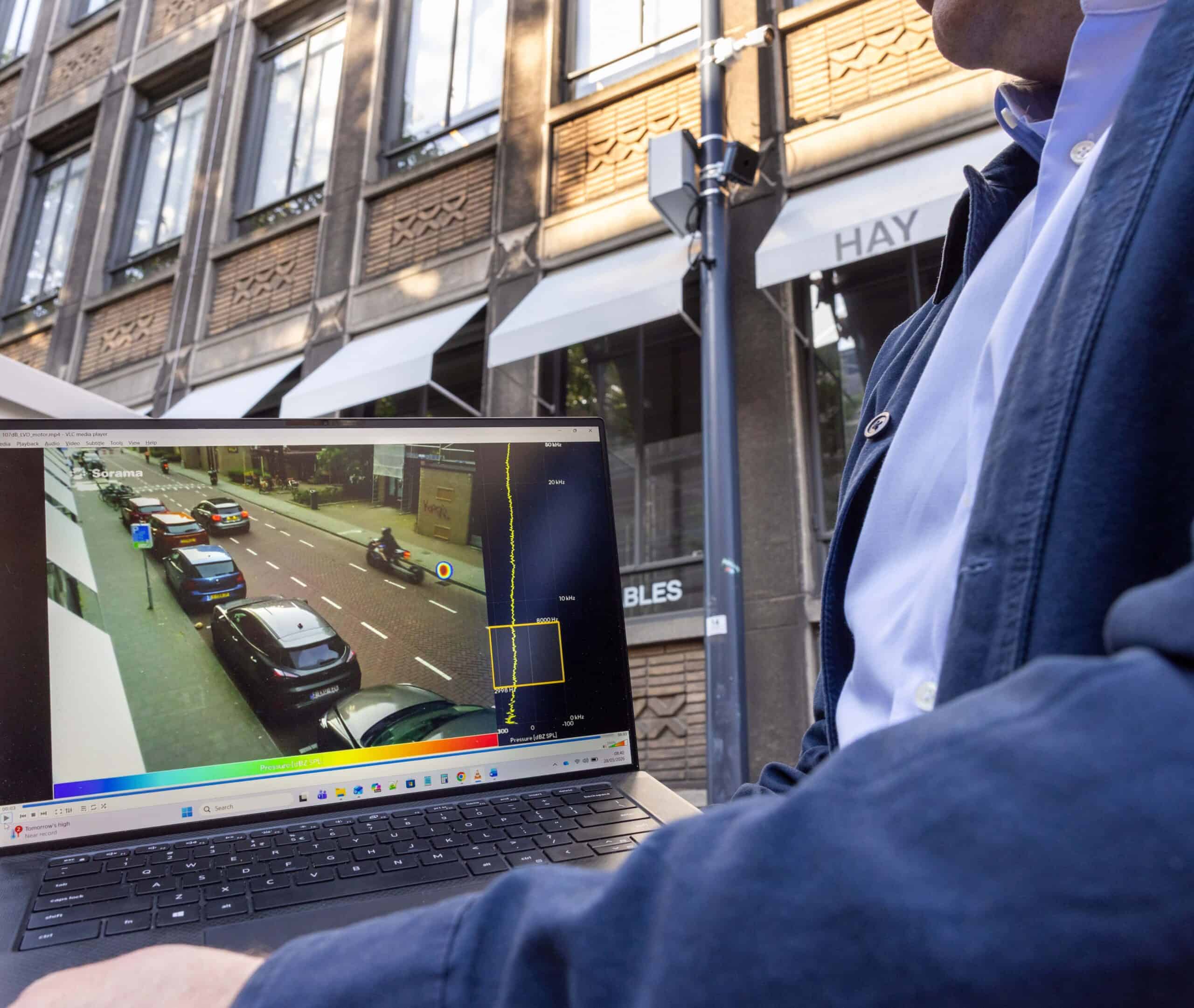 The dashboard for noise measurements using the new noise cameras, developed by technology company Sorama. Photo: Eric Fecken.
Legal steps come next
If the test succeeds, automated enforcement for unnecessary traffic noise still needs a legal basis. Only after those legal steps can the city start warning and fining offenders through the system.
The results of the pilot will be shared with the Public Prosecution Service’s traffic enforcement department, the CVOM. That step matters because the city cannot move from testing to automated penalties without legal backing.
Do you run a business? RotterdamStyle is looking for a main sponsor. Get exclusive visibility across our website for a fixed fee. Interested? Contact us 🤝
More Rotterdam locations follow
The pilot will be tested at four locations in total. For the first four weeks, the equipment is installed on Haagseveer and Strevelsweg.
After that, the pilot moves to Laan op Zuid and Maasboulevard. The first two roads have one lane in each direction, while Laan op Zuid and Maasboulevard are two-lane roads.
Different roads give better data
Rotterdam is deliberately testing the equipment in different traffic settings. Each location has its own background noise, traffic volume and street layout.
By using different types of roads, the municipality can see how the noise cameras perform in real Rotterdam conditions. That should make the pilot more useful than a test in one fixed, predictable setting.
Part of traffic nuisance approach
The pilot is part of the Rotterdam traffic nuisance approach, which includes 28 measures to reduce antisocial traffic behaviour in the city. The broader approach focuses on nuisance caused by road users who make the city feel less safe or more stressful.
More information about Rotterdam’s approach to traffic nuisance is available at https://www.rotterdam.nl/verkeersoverlast.