
What do you do when the landscape that holds your family's memories is slowly disappearing? In Time and Water, director Sara Dosa transforms Iceland's melting glaciers into an extraordinarily beautiful and moving documentary about love, loss and the passage of time, proving that a film about climate change can be as intimate as a family album and as breathtaking as the natural world itself.
Film details
- Title: Time and Water
- Dutch cinema release: 19 November 2026
- Director: Sara Dosa
- Runtime: 90 minutes according to Rotterdam cinema listings
- Genre: Documentary, nature, family
- Countries: Iceland, United States
- Languages: Icelandic and English
- Subtitles: Dutch
- Age rating: 6+
- Featuring: Andri Snær Magnason, Hulda Filippusdóttir and Árni Kjartansson
- Cinematography: Pablo Álvarez-Mesa
- Music: Dan Deacon
- Where to watch in Rotterdam: LantarenVenster and Cinerama
Do you run a business? RotterdamStyle is looking for a main sponsor. Get exclusive visibility across our website for a fixed fee. Interested? Contact us 🤝
What's the vibe?
Icelandic writer and poet Andri Snær Magnason has been given an unusual assignment. He must write a memorial inscription for Ok, a glacier that has disappeared because of climate change. But how do you say goodbye to something that has existed for thousands of years, shaped mountains and valleys, and helped define the landscape of an entire country?
To find an answer, Andri turns to his family history.
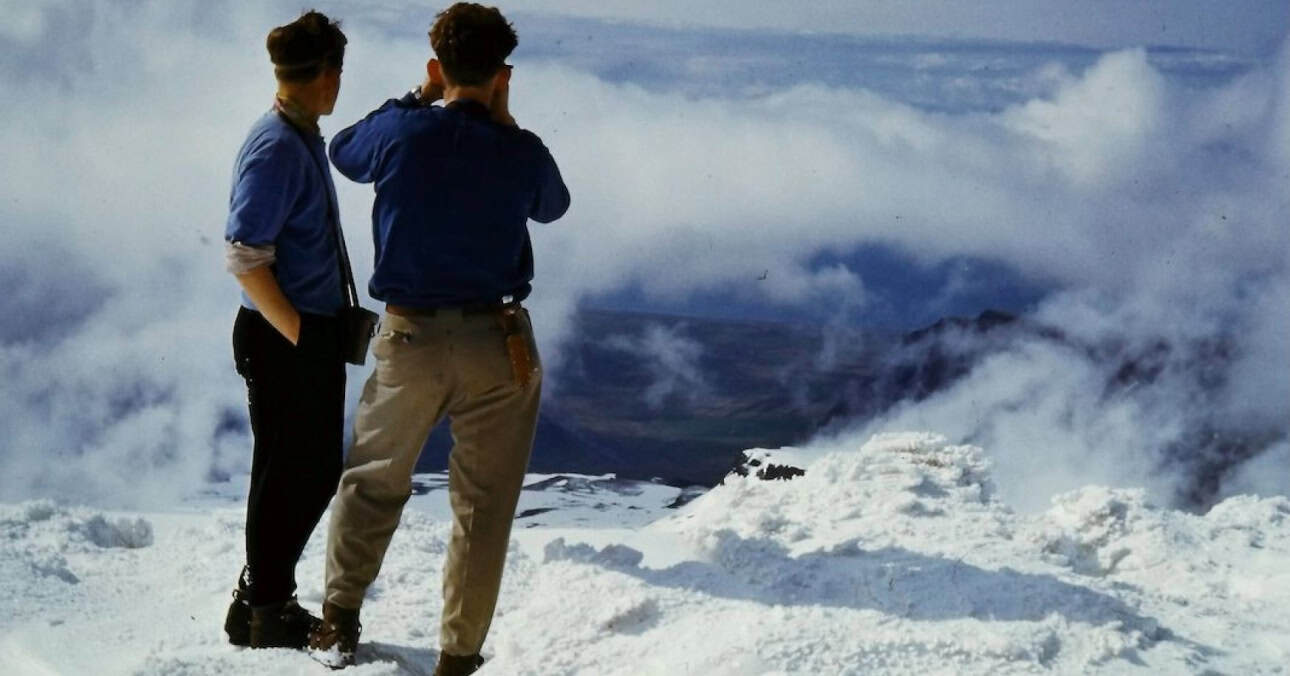
His grandparents, Hulda and Árni, were pioneering glacier researchers who spent their honeymoon exploring Vatnajökull, Iceland's largest glacier. Their photographs, home movies and memories reveal a world in which enormous rivers of ice seemed almost permanent, even as the people observing them grew older.
Director Sara Dosa weaves these intimate family archives together with extraordinary contemporary footage of Iceland's glaciers, ancient creation myths and Andri's reflections on memory, mortality and the natural world.
The result is something far more personal than a conventional environmental documentary.
Time and Water moves between the enormous timescale of geological history and the fleeting experiences of individual human lives. A glacier may exist for thousands of years, but a family photograph captures a moment that can never be repeated. Both preserve traces of the past, and both are vulnerable to disappearing.
There is plenty of melancholy here, naturally, but Dosa is equally interested in wonder. The film's spectacular landscapes, gently humorous family memories and almost otherworldly images of blue ice create an atmosphere that feels closer to a cinematic poem than a scientific lecture.
You may arrive expecting a documentary about melting glaciers and leave thinking about your grandparents.
Trailer
Check out the trailer below.
Do you run a business? RotterdamStyle is looking for a main sponsor. Get exclusive visibility across our website for a fixed fee. Interested? Contact us 🤝
Why you might like it
- Eyes: Extraordinary footage of Icelandic glaciers, luminous blue ice caves, vast frozen landscapes and archival photographs that transform the country's geological history into something almost dreamlike.
- Heart: The relationship between Andri and his grandparents gives the film its emotional foundation, connecting the disappearance of glaciers with the universal experience of losing people, places and memories we love.
- Mind: Time and Water invites us to reconsider how we understand time itself, contrasting the relatively brief span of human lives with the thousands of years recorded in layers of ice.
Critical reception
Time and Water has received an excellent critical response, with reviewers particularly impressed by its cinematography, emotional intelligence and imaginative approach to environmental storytelling.
As of 17 November, Rotten Tomatoes gives the film 91% from 46 critic reviews, with an average rating of 7.3 out of 10. Its critical consensus praises the documentary's visual beauty and ability to combine an intimate family portrait with an enormous environmental subject.
Metacritic gives the film 76 out of 100 from 14 reviews, indicating generally favourable reception. Twelve reviews are positive, two are mixed and none fall into the site's negative category.
IndieWire was particularly enthusiastic, awarding the film 100 out of 100. Critic Marya E. Gates admired Dosa's combination of autobiography, nature documentary and environmental reflection, praising its ability to transform the disappearance of Iceland's glaciers into something deeply personal.
The Los Angeles Times awarded it 90 out of 100, highlighting how the film's reflections on family history and environmental change reinforce one another. Rather than presenting the glaciers simply as impressive natural formations, the documentary invites viewers to understand them as part of a living cultural inheritance.
RogerEbert.com was similarly impressed, giving the film 3.5 out of 4 stars and praising its treatment of memory, time and the difficulty of preserving things that are disappearing before our eyes.
Little White Lies argued that Dosa finds a particularly effective way to communicate the climate crisis by approaching it through memory rather than scientific statistics alone.
Not every critic was equally enthusiastic.
The Guardian gave the film a much more critical review, arguing that its gentle, elegiac approach sometimes feels inadequate to the urgency of the climate crisis. Time Out awarded three stars, admiring the imagery and Dan Deacon's atmospheric score while finding parts of the film overly contemplative.
The difference largely comes down to expectations. Viewers seeking a detailed investigation into climate policy or the scientific mechanisms of global warming may find the film too impressionistic. Anyone interested in documentary filmmaking as an art form, however, will find plenty to admire.
Do you run a business? RotterdamStyle is looking for a main sponsor. Get exclusive visibility across our website for a fixed fee. Interested? Contact us 🤝
Awards and festival recognition
Time and Water had its world premiere at the 2026 Sundance Film Festival, where it attracted considerable attention for its visual ambition and personal approach to climate storytelling.
Its festival journey subsequently included screenings at SXSW, CPH, the San Francisco International Film Festival, Hot Docs and Sheffield DocFest.
The film also received two nominations at the 2026 Critics Choice Documentary Awards:
- Best Science/Nature Documentary
- Best Music Score: Dan Deacon
It has additionally received nominations connected to the San Francisco International Film Festival and other documentary festivals.
The film's Dutch premiere forms part of the 2026 International Documentary Film Festival Amsterdam (IDFA), where it appears in the Signed programme, a selection celebrating filmmakers with distinctive artistic voices.
Scene to watch for
Pay particular attention to the sequences in which Andri's family explores Iceland's immense glaciers.
His grandmother Hulda recalls the unusual smell of a glacier in spring, something she finds both exhilarating and almost impossible to describe. Elsewhere, the film explores the extraordinary blue colours hidden deep within ancient ice.
The deeper the blue, the older the ice.
These moments reveal one of the documentary's most compelling ideas. Glaciers are not simply enormous blocks of frozen water. Their layers preserve evidence of the atmosphere, climate and environmental conditions from long before any of us were born.
Dosa's camera moves through vast chambers of blue ice, transforming this scientific reality into an almost otherworldly visual experience.
It is difficult to watch these extraordinary images without considering what disappears when a glacier melts.
And it is equally difficult not to understand why Andri's grandparents spent so much of their lives exploring them.
Recommended pairing
Time and Water deserves a little breathing room, so consider making it part of a relaxed afternoon or evening rather than rushing straight into the screening.
A warming bowl of soup, freshly baked bread or a good cup of coffee would make an excellent pre-film combination, particularly during Rotterdam's increasingly chilly November weather.
Afterwards, take a walk along the Maas and spend a few minutes watching the water. It is hardly an Icelandic glacier, but the film might make you look differently at something as ordinary as a river.
If you are watching with friends or family, this is also a lovely opportunity to exchange stories about places you remember from childhood and the relatives who introduced you to them.
You may discover that some of the most important landscapes in your life have very little to do with spectacular scenery.
Do you run a business? RotterdamStyle is looking for a main sponsor. Get exclusive visibility across our website for a fixed fee. Interested? Contact us 🤝
Need-to-knows
From volcanoes to glaciers
Time and Water is directed by Sara Dosa, whose previous documentary, Fire of Love (2022), received an Academy Award nomination for Best Documentary Feature.
That film followed French volcanologists Katia and Maurice Krafft, a married couple whose extraordinary relationship was inseparable from their fascination with volcanoes.
With Time and Water, Dosa returns to the relationship between human beings and the natural world, this time replacing fire with ice.
Both films combine spectacular natural imagery with intimate personal stories, allowing their subjects' emotional lives to give meaning to environmental phenomena that might otherwise seem impossibly distant.
The connection extends behind the camera. Time and Water was produced by National Geographic Documentary Films, with several members of Dosa's earlier creative team returning for the project.
The real glacier behind the story
Okjökull, usually shortened to Ok, was a glacier in western Iceland that lost its recognised glacier status in 2014 after shrinking so dramatically that it could no longer behave as a glacier.
In August 2019, scientists, politicians and environmental activists gathered to commemorate its disappearance.
A memorial plaque was installed on the mountain, featuring a text written by Andri Snær Magnason.
The inscription addresses future generations and warns that humanity knows what is happening to the planet, while leaving open the question of whether sufficient action will be taken.
The ceremony became an internationally recognised symbol of the effects of climate change.
For Andri, however, the disappearance of Ok carries an additional meaning. It represents the loss of a landscape deeply connected to his family's identity and history.
A book about time
The documentary draws on ideas developed in Andri Snær Magnason's book On Time and Water, first published in Icelandic in 2019.
The book combines science, mythology, personal history and environmental reflection to explore how human beings understand changes occurring over timescales far longer than their own lives.
It has since been translated into more than 30 languages.
Dosa's documentary uses many of the same themes but gives them a distinctly cinematic form through archival footage, contemporary photography and personal narration.
The film also explores Icelandic creation myths, including an ancient story in which fire and ice meet to produce the first living beings and shape the landscape.
These myths provide an imaginative contrast to the scientific understanding of glaciers, suggesting that the relationship between Icelanders and their environment has always involved both knowledge and storytelling.
The music behind the images
The original score was composed by American musician Dan Deacon, known for his experimental electronic music and distinctive use of layered sounds.
His compositions give the film a dreamlike quality, moving between delicate passages and expansive sequences that seem to echo the scale of the landscape.
The music plays an important role in connecting the film's personal memories with its spectacular natural imagery.
Deacon's work earned a nomination for Best Music Score at the 2026 Critics Choice Documentary Awards.
Part of IDFA Rotterdam 2026
One of the strongest reasons to see Time and Water this week is its inclusion in IDFA Rotterdam 2026.
From Thursday 19 to Sunday 22 November, LantarenVenster hosts a selection of films from the International Documentary Film Festival Amsterdam, bringing part of the festival's programme directly to Rotterdam.
That makes it possible to experience acclaimed international documentaries without travelling to Amsterdam.
Time and Water is particularly well suited to the programme, combining a distinctive artistic approach with a subject that connects individual experiences to a much larger global issue.
The film's appearance at IDFA also marks its Dutch festival premiere, following its international festival run earlier this year.