

Looking for the best places to take photographs in Rotterdam? From the unmistakable Erasmus Bridge and futuristic Cube Houses to historic Delfshaven and the peaceful Kralingse Plas, Rotterdam offers plenty of opportunities to capture something special.
One of the things we love about photographing Rotterdam is the variety. You can spend the morning shooting centuries-old architecture, have lunch beneath an enormous work of art and finish the day photographing one of Europe's most recognisable modern skylines. And you don't necessarily need an expensive camera. Many of these places look fantastic through a smartphone lens.
Here are ten of our favourite photography spots in Rotterdam, with a few tips on where to stand and how to get the most interesting shots.
Do you run a business? RotterdamStyle is looking for a main sponsor. Get exclusive visibility across our website for a fixed fee. Interested? Contact us 🤝
1. Rotterdam Centraal and Delftse Poort
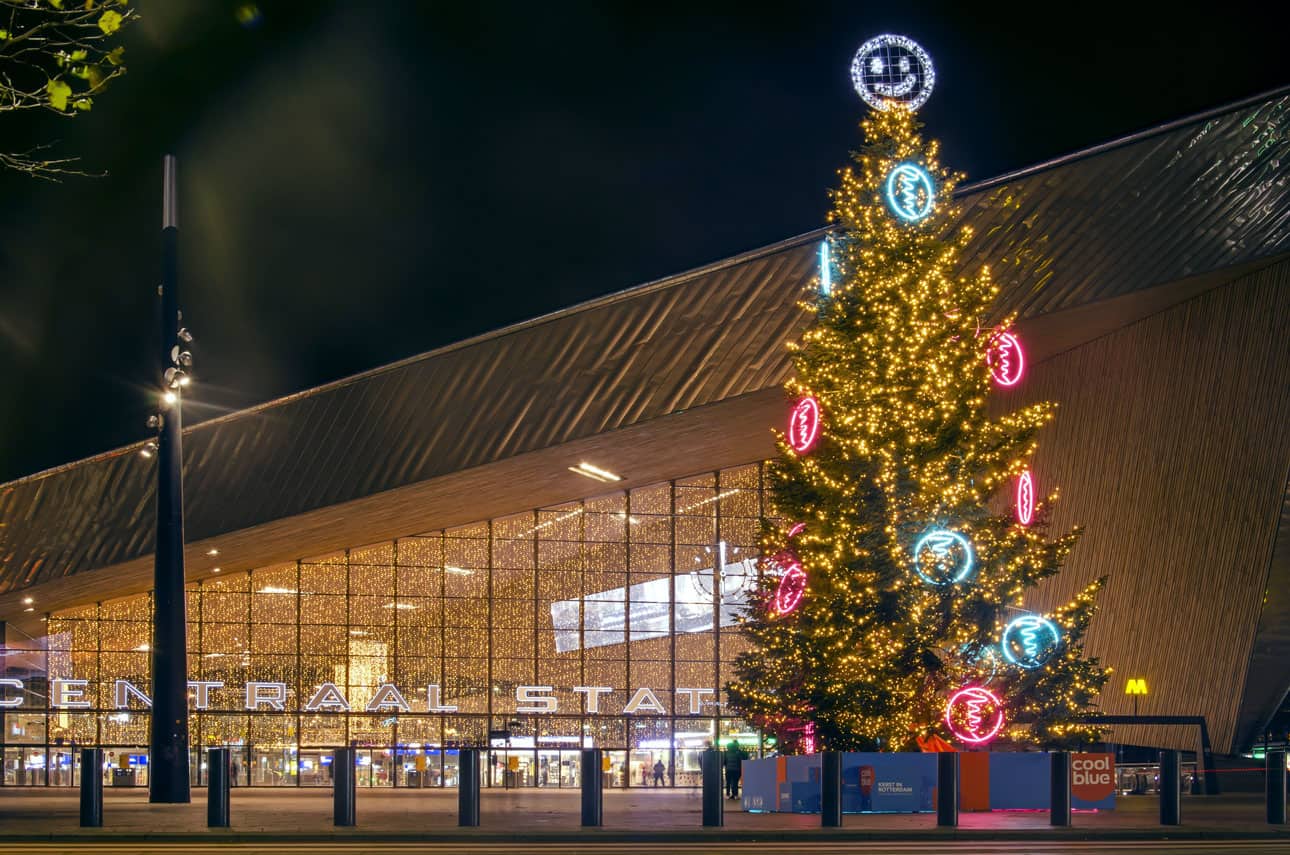
 Rotterdam Centraal railway station and its distinctive angular entrance
Chances are Rotterdam Centraal will be your first stop when visiting the city, and it's a good place to start taking photographs. The station's striking angular entrance, enormous glass windows and sharp architectural lines make it one of Rotterdam's most recognisable modern buildings.
The original station opened in 1957, but the building you see today is an entirely new design by Team CS, officially opened by King Willem-Alexander on 13 March 2014.
For the classic photograph, stand on Stationsplein and capture the entire entrance, including the distinctive roof pointing towards the city centre. Try moving closer to emphasise the lines and angles, or photographing from inside the station towards the enormous glass façade.
 Reflective glass towers of Delftse Poort beside Rotterdam Centraal
While you're there, don't forget to turn your camera towards Delftse Poort, the twin office towers next to the station, home to Nationale-Nederlanden and other businesses.
The reflective glass façade produces some wonderful effects on bright days. Depending on the weather and angle, you'll see clouds, blue skies and nearby buildings reflected across the towers. A sunny day with scattered clouds can be particularly rewarding.
Photography tip: Start with a wide-angle shot from Stationsplein, then experiment with the mirrored façades of Delftse Poort. Look for reflections that create almost abstract compositions.
Do you run a business? RotterdamStyle is looking for a main sponsor. Get exclusive visibility across our website for a fixed fee. Interested? Contact us 🤝
2. Rotterdam City Hall (Stadhuis)
 Rotterdam City Hall on Coolsingel. Photo: Ossip van Duivenbode
People who have never visited Rotterdam sometimes imagine a city consisting entirely of modern buildings. Rotterdam City Hall is a good place to challenge that assumption.
Located on Coolsingel, the impressive building was designed by Henri Evers and constructed between 1914 and 1920. It is one of the few prominent buildings in Rotterdam's city centre to have survived the devastating German bombing of 14 May 1940.
Its elaborate façade, central tower, sculptures and decorative details offer a very different kind of architecture photography from the glass and steel found elsewhere in the city.
You can photograph the building from the opposite side of Coolsingel to capture its full width, or move closer to concentrate on its architectural details.
Photography tip: Try photographing the City Hall from a low angle to emphasise the tower and its decorative architecture. Early morning light can be particularly attractive, especially when there's less activity along Coolsingel.
Do you run a business? RotterdamStyle is looking for a main sponsor. Get exclusive visibility across our website for a fixed fee. Interested? Contact us 🤝
3. Depot Boijmans Van Beuningen
 Mirrored façade of Depot Boijmans Van Beuningen in Rotterdam's Museumpark
One of Rotterdam's most unusual buildings is the Depot Boijmans Van Beuningen, a gigantic reflective bowl standing in Museumpark.
Designed by Rotterdam architecture firm MVRDV, the building opened in 2021 as the world's first publicly accessible art storage facility. Its mirrored exterior consists of 1,664 panels that reflect the surrounding skyline, trees and people passing by.
Unlike a conventional museum, where selected artworks are arranged in exhibition galleries, the Depot gives visitors a look behind the scenes of storing, preserving and managing a large art collection. You can see works through the storage areas, watch conservation activities and join guided visits to selected compartments.
But even if you never enter the building, the exterior alone is worth photographing.
The curved mirrors distort the surroundings, creating unusual reflections that change depending on the weather, time of day and where you're standing. Walk around the building and you'll discover that almost every angle offers something different.
There's also a rooftop with trees and panoramic views of Rotterdam. Access requires the appropriate ticket and depends on the opening schedule and weather conditions. You can check the official Depot ticket information before visiting.
Photography tip: Look for reflections of the Rotterdam skyline across the curved surface. A partly cloudy sky can be especially effective. For something different, move close to the façade and use its distorted reflections as the subject of your photograph.
Do you run a business? RotterdamStyle is looking for a main sponsor. Get exclusive visibility across our website for a fixed fee. Interested? Contact us 🤝
4. St Laurenskerk (Grote Kerk)
 Historic Laurenskerk in Rotterdam. Photo: Iris van den Broek
Right in the middle of Rotterdam's modern city centre stands the Laurenskerk, also known as the Grote of Sint-Laurenskerk. It's the only surviving medieval building in the historic centre of Rotterdam.
Construction began in 1449, and the church reached its present late-Gothic form in the early sixteenth century.
During the German bombing of Rotterdam on 14 May 1940, the church was severely damaged by fire. Its roof and much of its interior were destroyed, leaving the walls and tower standing amid the ruins of the city centre.
Restoration began in 1952 and was completed in 1968, making the Laurenskerk one of the city's most powerful symbols of survival and reconstruction.
Photographing the building can be a fun challenge. Its enormous Gothic structure stands relatively close to surrounding streets and buildings, making it difficult to fit everything into a single frame.
Move around Grotekerkplein and experiment with different perspectives. The contrast between the church's historic stonework and the surrounding modern architecture is particularly interesting.
Photography tip: A wide-angle lens is useful when photographing the entire church. If you prefer architectural details, concentrate on the windows, stonework and tower. During the visitor season, the tower can also be climbed for views across the city, subject to opening arrangements.
Do you run a business? RotterdamStyle is looking for a main sponsor. Get exclusive visibility across our website for a fixed fee. Interested? Contact us 🤝
5. Erasmus Bridge and De Rotterdam
 Erasmus Bridge and the Rotterdam waterfront
No Rotterdam photography guide would be complete without the Erasmusbrug. Known locally as De Zwaan (The Swan), the bridge is probably the city's most famous architectural landmark.
Designed by Ben van Berkel, construction began in 1993, and Queen Beatrix officially opened the bridge on 4 September 1996.
Its 139-metre-high pylon, sweeping cables and elegant silhouette make it an obvious subject for photographers. But finding an interesting angle is where the fun begins.
Most visitors photograph the bridge from the northern waterfront at Willemsplein or from the southern side near Wilhelminapier. Both are excellent starting points, but we'd also recommend walking further along the river or taking a water taxi for a different perspective.
One of our favourite viewpoints is the Willemsbrug, further upstream. From there, you can capture a broad view of the river, with the Erasmus Bridge and Rotterdam's skyline in the distance.
For more about Rotterdam's famous river crossings, see our guide to the bridges of Rotterdam.
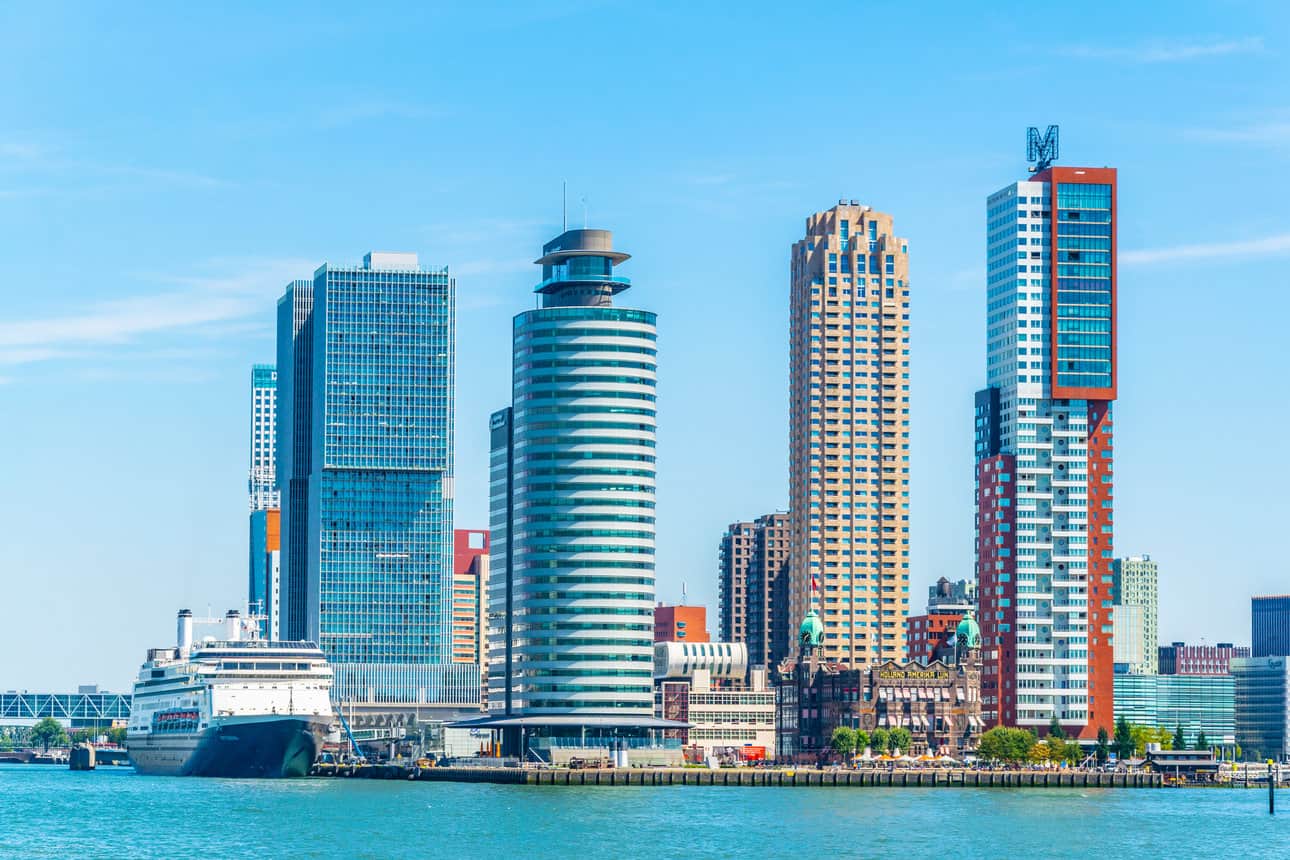
 Erasmus Bridge and De Rotterdam illuminated against the evening skyline
Another idea is to photograph the Erasmus Bridge with De Rotterdam in the background. The enormous three-tower complex was designed by Rem Koolhaas' Office for Metropolitan Architecture (OMA) and completed in 2013.
Conceived as a vertical city, it contains offices, apartments, a hotel and other facilities. The building's rectangular forms provide a striking contrast with the graceful cables and curves of the Erasmus Bridge.
Together, they make one of the most recognisable compositions in Rotterdam.
Photography tip: Visit around sunset or during blue hour, when the sky still has colour but the buildings and bridge lights are beginning to shine. Bring a tripod if you want to experiment with longer exposures, particularly to capture light trails from passing boats.
Do you run a business? RotterdamStyle is looking for a main sponsor. Get exclusive visibility across our website for a fixed fee. Interested? Contact us 🤝
6. Historic Delfshaven
 Historic Aelbrechtskolk harbour in Delfshaven, Rotterdam
If you came to the Netherlands expecting old canals, traditional architecture and picturesque waterfronts, and then found yourself surrounded by Rotterdam's modern skyline, don't worry. Historic Delfshaven has exactly what you're looking for.
Head towards Aelbrechtskolk, where the old harbour, traditional houses, boats and cobbled streets provide a completely different photographic atmosphere.
Delfshaven originally developed as the port of Delft in the late fourteenth century. Much of its historic character survived the destruction that transformed central Rotterdam during the Second World War.
The area is also associated with the Pilgrims, who departed from Delfshaven for England in 1620 before continuing their journey to North America. Dutch naval officer Piet Hein was born here.
Today, Delfshaven offers some of Rotterdam's most atmospheric streets, with old buildings reflected in the water and small bridges providing excellent viewpoints.
Unlike the more modern locations on this list, the charm here lies in the little details. Look for traditional windows, moored boats, brickwork, historic façades and the reflections in the harbour.
Photography tip: Visit early in the morning when the water is calm and there are fewer people around. Reflections can be especially attractive, while overcast conditions often produce soft, flattering light for photographing historic buildings.
Do you run a business? RotterdamStyle is looking for a main sponsor. Get exclusive visibility across our website for a fixed fee. Interested? Contact us 🤝
7. Kralingse Plas and Kralingse Bos
 De Lelie windmill beside Kralingse Plas. Photo: Jchmrt
Rotterdam isn't all concrete, glass and steel. If you're in the mood for nature and landscape photography, head towards Kralingse Plas and the surrounding Kralingse Bos.
This large park and lake in the eastern part of Rotterdam offer a completely different atmosphere from the city centre. You can photograph woodland paths, wildlife, sailing boats, water reflections and wide views across the lake towards the Rotterdam skyline.
Two historic windmills, De Ster and De Lelie, stand beside the water and are particularly rewarding subjects. Their traditional architecture provides an interesting contrast with the modern city visible in the distance.
There are numerous paths around the lake, so spend some time exploring rather than settling on the first viewpoint you encounter.
One of our favourite aspects of the Kralingse Plas is the way the atmosphere changes with the weather. On a clear day, the lake can look bright and peaceful. When clouds gather, the same landscape can take on an entirely different mood.
Photography tip: Try photographing the windmills with the lake in the foreground, or head to the shoreline for a wide composition featuring the Rotterdam skyline. Early morning mist and the golden light before sunset can produce particularly beautiful results.
Do you run a business? RotterdamStyle is looking for a main sponsor. Get exclusive visibility across our website for a fixed fee. Interested? Contact us 🤝
8. Markthal
 Markthal Rotterdam illuminated in the evening. Photo: Paul Arps
From the outside, Rotterdam's Markthal looks a little like an enormous horseshoe or bread bin. Step inside, however, and you'll discover why people sometimes call it Rotterdam's Sistine Chapel.
The gigantic artwork covering the building's curved interior is called Horn of Plenty, created by artists Arno Coenen and Iris Roskam. Its enormous images of fruits, vegetables, flowers, fish and insects stretch across the ceiling above the food market.
The building itself, designed by MVRDV and opened in 2014, combines a covered food market with apartments built into the enormous arch.
For exterior photographs, the Markthal is particularly impressive towards dusk, when its illuminated interior begins to stand out against the evening sky.
Inside, look upwards and experiment with the symmetry of the enormous artwork. A wide-angle lens is useful for capturing as much of the ceiling as possible.
You can also photograph the Markthal together with the nearby Cube Houses or the distinctive residential building known as Het Potlood (The Pencil).
Photography tip: For an exterior photograph, stand back far enough to include the full arch. Inside, try photographing from the centre of the hall for a symmetrical view of the ceiling. Remember that this is also a busy food market, so be considerate when photographing vendors and visitors.
Do you run a business? RotterdamStyle is looking for a main sponsor. Get exclusive visibility across our website for a fixed fee. Interested? Contact us 🤝
9. Cube Houses (Kubuswoningen)
 Yellow Cube Houses designed by Piet Blom in Rotterdam
Rotterdam's famous Cube Houses are among the city's most photographed attractions, and for good reason. Designed by architect Piet Blom and completed in 1984, these bright yellow houses look as though somebody picked up ordinary buildings and tilted them onto their corners.
The unusual shapes make them especially interesting to photograph, although finding the right composition can be surprisingly difficult.
One fun challenge is to look at photographs of the Cube Houses online and then try to recreate the same perspective yourself. You'll quickly discover that some angles are much harder to find than they first appear.
Walk through the complex, look upwards and experiment with the repeating shapes. The combination of strong colours, diagonal lines and geometric patterns makes this a fantastic location for architectural photography.
The Cube Houses are located beside Station Blaak, just across from the Markthal. There is also a museum house, the Kijk-Kubus, where visitors can explore what living inside one of these unusual buildings is like.
Photography tip: Try shooting upwards from beneath the cubes to create dramatic geometric compositions. A wide-angle lens can help, but don't be afraid to crop tightly and concentrate on individual shapes or repeating patterns.
Do you run a business? RotterdamStyle is looking for a main sponsor. Get exclusive visibility across our website for a fixed fee. Interested? Contact us 🤝
10. Oude Haven and the Witte Huis
 Oude Haven with historic boats, the Witte Huis and Willemsbrug
Across from the Cube Houses, you'll find Oude Haven, one of Rotterdam's oldest harbour areas and another excellent place to spend some time with your camera.
The harbour is home to historic vessels, waterfront terraces and one of Rotterdam's most remarkable surviving buildings: the Witte Huis.
Completed in 1898, this white Art Nouveau office building is widely regarded as one of Europe's earliest skyscrapers. Inspired by the tall office buildings appearing in American cities at the time, it was an extraordinary achievement for Rotterdam at the end of the nineteenth century.
Today, the Witte Huis provides a striking contrast with the modern architecture visible elsewhere around the harbour.
From the quayside, you can capture traditional boats in the foreground with the Witte Huis and red Willemsbrug in the background. It's a combination of old and new Rotterdam that's difficult to find anywhere else.
The harbour is also surrounded by cafés and restaurants, making it an excellent place to finish a photography walk with lunch or a drink.
Photography tip: Explore the quays around Spaansekade and Geldersekade. Look for opportunities to frame the Witte Huis between historic boats, or visit during blue hour when the waterfront lights reflect in the water.
A few extra photography tips for Rotterdam
Rotterdam rewards a little experimentation. Some locations look their best on bright sunny days, while others become more interesting when the weather turns cloudy or the city lights come on.
- Try blue hour: The period shortly after sunset is ideal for photographing the Erasmus Bridge, Markthal and Oude Haven.
- Look for reflections: Rotterdam has plenty of glass buildings, canals and waterfronts that can give your photographs an entirely different perspective.
- Experiment with angles: The Cube Houses, Rotterdam Centraal and Depot Boijmans are particularly rewarding when photographed from unusual positions.
- Bring a wide-angle lens: It's especially useful for large buildings such as the Laurenskerk, Markthal and Rotterdam Centraal.
- Don't ignore the weather: Clouds can create dramatic skies, while rain can introduce interesting reflections on streets and pavements.
If you need photography equipment or advice while visiting Rotterdam, Kamera Express has a store at Karel Doormanstraat 263 in the city centre.
Most importantly, take your time. Rotterdam has a habit of revealing interesting details when you wander a little further than you originally planned. Sometimes the best photograph of the day isn't the famous landmark you came to see, but something unexpected you noticed along the way.